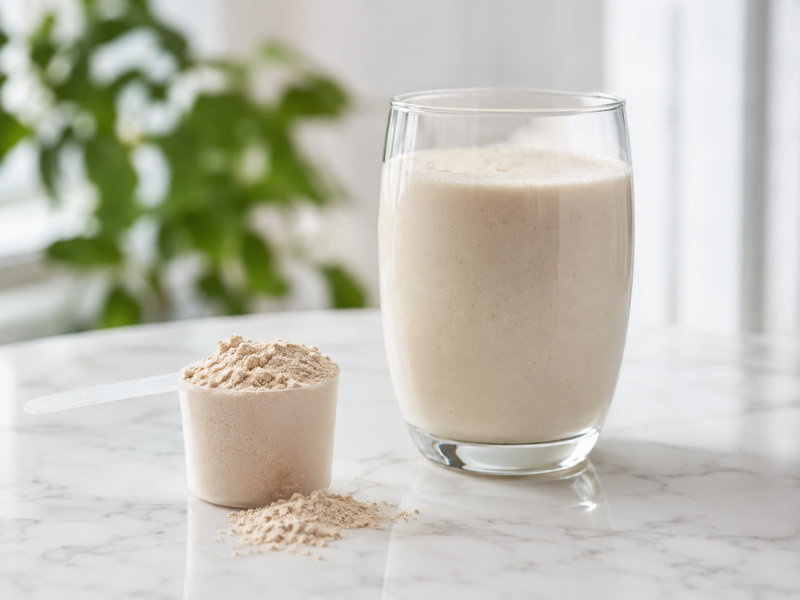
How Much Creatine Should You Take Per Day?
For most healthy adults, 3–5 g of creatine monohydrate per day is a practical long-term approach. Loading can increase muscle creatine stores faster, but it is optional rather than compulsory.
Key Takeaways
Creatine Dosage Does Not Need to Be Complicated
Ask five gym-goers about creatine dosage and you may hear five different answers: three grams, five grams, twenty grams for a week, before training, after training, or only on workout days.
The reality is simpler. For most healthy adults, 3–5 g of creatine monohydrate every day is a sensible long-term approach. Regular supplementation gradually increases creatine stored in the muscles, supporting repeated high-intensity exercise and training adaptations.
“When considering creatine dosage for muscle growth, think consistency first.”
How Much Creatine Should You Take Per Day?
For most people, 3–5 g daily is the sensible starting point. A 5 g serving is convenient and easy to remember, while 3 g is also an established approach that may simply take longer to fully saturate muscle creatine stores.
| Daily Amount | Best Understood As |
|---|---|
| 3 g/day | A reasonable everyday maintenance approach. |
| 5 g/day | A simple, widely used daily option. |
| More than 5 g/day | Generally more relevant to loading protocols than routine supplementation. |
Loading vs. Maintenance: What Is the Difference?
A traditional creatine loading phase uses around 20–25 g per day for 5–7 days, normally divided into several smaller servings. It is then followed by a maintenance dose of around 3–5 g per day.
Faster Saturation
Around 20–25 g per day for 5–7 days, divided into smaller servings, followed by maintenance.
Slower Saturation
Taking 3–5 g every day can reach similar saturation levels more gradually, over roughly three to four weeks.
Do You Need a Creatine Loading Phase?
Loading can be useful when someone wants to increase muscle creatine stores quickly, but most recreational gym-goers do not need to rush the process.
Larger amounts can cause gastrointestinal discomfort in some users, especially when taken in a large single dose. Dividing loading doses throughout the day can help.
What About Creatine Timing?
Creatine timing is much less important than consistency. The long-term goal is to maintain elevated muscle creatine stores rather than create an immediate pre-workout sensation.
Should You Take Creatine on Rest Days?
Yes. If your routine is based on daily supplementation, creatine on rest days still makes sense because the goal is to maintain muscle creatine stores over time.
Does Your Body Weight Change the Dose?
Body weight can matter, particularly during loading. A commonly cited loading protocol is approximately 0.3 g/kg/day for 5–7 days, followed by 3–5 g/day for maintenance.
That does not mean everyone needs to calculate a maintenance dose to the decimal point. For most recreational lifters, 3–5 g/day remains a practical range. Some larger athletes may use higher maintenance amounts.
Does More Creatine Mean Better Results?
Not necessarily. Once muscle creatine stores are sufficiently elevated, taking substantially more does not automatically mean substantially better results.
“The smarter question is not ‘How much can I take?’ It is ‘What dose can I take consistently?’”
Hydration Still Matters — Just Not for the Reason You Think
Standard creatine supplementation has not been shown to inherently cause dehydration or muscle cramping in healthy exercising individuals.
Creatine does not replace basic training and nutrition habits. It sits alongside them.
A Simple Creatine Decision Guide
✔ Simple Creatine Checklist
Where QNT Creatine Fits In
QNT Creatine Monohydrate Powder provides 3,000 mg of creatine monohydrate per serving in a 100% micronized formula, with 83 servings in the 250 g pack.
That makes it easy to build a straightforward daily routine around a practical 3 g serving.
View QNT CreatineThe Bottom Line
For most healthy adults, 3–5 g of creatine monohydrate per day is a practical maintenance dose.
- Load only if you want faster saturation.
- Take creatine consistently, including on rest days.
- Do not obsess over timing.
- Do not double your serving after a missed day.
- Do not assume a bigger scoop automatically means bigger results.
Frequently Asked Questions
How much creatine should you take per day?
For most healthy adults, 3–5 g of creatine monohydrate per day is a practical maintenance range. Individual protocols can vary, particularly when a loading phase is used.
Is 5 g of creatine a day enough?
Yes. Five grams daily is a widely used approach and can maintain elevated muscle creatine stores after saturation. It can also be used without loading, although saturation takes longer.
Should beginners take 3 g or 5 g of creatine?
Both can work. Three grams is a reasonable daily approach, while 5 g is a simple option for people who prefer an easy-to-remember routine.
Do you need a creatine loading phase?
No. Loading can saturate muscle creatine stores faster, but consistent daily supplementation at 3–5 g can achieve similar saturation more gradually.
Should you take creatine on rest days?
Yes. If you are following a daily supplementation routine, taking creatine on rest days helps maintain consistency and elevated muscle creatine stores.
References
- International Society of Sports Nutrition — Creatine Supplementation in Exercise, Sport, and Medicine
- Common Questions and Misconceptions About Creatine Supplementation: What Does the Scientific Evidence Really Show?
- Creatine Supplementation With Specific View to Exercise/Sports Performance: An Update
- International Society of Sports Nutrition — Creatine Supplementation and Exercise
- QNT Creatine Monohydrate Powder — 250 g