Key Takeaways
“How Can I Have PCOS When I'm Fit?”
You train several times a week. Your meals are reasonably balanced. Your weight is normal. Maybe you even look like the healthiest person in your friend group.
Yet your period keeps disappearing. Acne appears around your jawline, your hair feels thinner, facial hair becomes more noticeable or your energy feels unpredictable.
That can feel contradictory, but body weight is not a diagnostic test for PCOS. PCOS—renamed Polyendocrine Metabolic Ovarian Syndrome (PMOS) by the international guideline group in May 2026—can affect women across different body sizes. The familiar term PCOS is used here because it remains the commonly recognised term.
What Does “Lean PCOS” Actually Mean?
Lean PCOS generally describes PCOS in someone who is not overweight. It is not a completely different condition. Diagnosis relies on reproductive and androgen-related features rather than appearance alone.
Ovulation
Irregular or absent ovulation can appear as consistently irregular or missing periods.
Androgen Signs
Clinical or biochemical androgen elevation may appear through acne, excess hair growth or scalp hair thinning.
Ovarian Assessment
Ultrasound findings or, in appropriate adults, AMH may form part of the diagnostic algorithm.
Signs You Should Not Ignore
- ✓ Consistently irregular periods
- ✓ Periods that disappear
- ✓ Difficulty conceiving
- ✓ Persistent acne or oily skin
- ✓ Increased facial or body hair
- ✓ Hair thinning on the scalp
- ✓ Persistent fatigue
- ✓ Sleep problems
- ✓ Poor recovery alongside cycle changes
“Looking fit does not tell you whether ovulation and androgen regulation are normal.”
“I Exercise and Eat Healthy. Why Is My Period Still Missing?”
This is where self-diagnosis becomes risky. Two active women may have the same symptom—missing periods—but very different underlying causes.
Possibility: PCOS
PCOS can involve altered androgen production, irregular ovulation and metabolic changes even when BMI is not elevated.
Insulin resistance is recognised within PCOS biology, but routinely available insulin tests have limited clinical usefulness and should not automatically be used to diagnose or monitor it.
Possibility: Under-Fuelling
Functional hypothalamic amenorrhea can occur when energy intake is too low relative to training demands. Stress and restrictive eating can contribute too.
Someone may be eating very “clean” while still eating too little to support training and reproductive function.
PCOS vs Under-Fuelling: Why the Difference Matters
| Factor | PCOS | Low Energy Availability / FHA |
|---|---|---|
| Periods | May be irregular or absent | May become irregular or stop |
| Androgen signs | Acne, increased hair growth or scalp thinning may occur | Not necessarily a defining feature |
| Training relationship | Can occur regardless of exercise level | Often associated with inadequate energy relative to exercise |
| Why diagnosis matters | Requires individualised PCOS management | May require more energy and/or less training stress |
What Should You Do If Your Cycle Is Irregular?
Start with evaluation—not another supplement and not additional cardio. A clinician can look at the complete pattern rather than one isolated symptom.
Review Your Cycle
Note missed periods, cycle length and how long changes have been happening.
Review Training & Food
Consider exercise volume, calorie restriction, stress and recovery.
Discuss Testing
Testing may include androgen markers and evaluation for other endocrine causes.
Treat the Actual Cause
Build nutrition, training and medical care around the confirmed problem.
Build Your Fitness Routine Around Recovery Too
Exercise can remain an important part of PCOS management. For women who are not overweight, the goal does not need to be unnecessary weight loss. General health, sustainable activity and adequate recovery matter.
- Three structured resistance-training sessions
- One or two moderate cardio sessions
- Regular walking and everyday movement
- At least one proper recovery day
- Sufficient food to support training
- Consistent, adequate sleep
Strength training can remain part of a healthy routine, but more HIIT is not automatically better when recovery and energy availability are already poor.
Your Diet Should Support the Training You're Doing
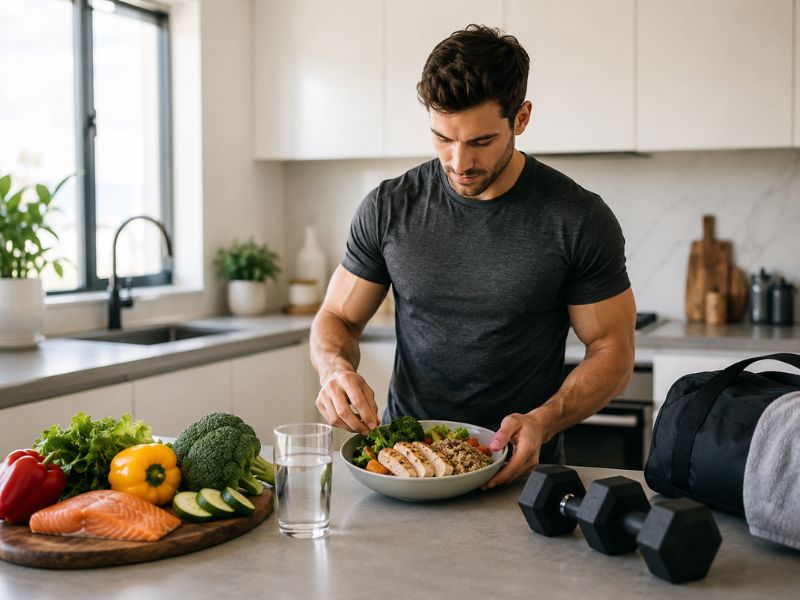
If you train hard while repeatedly cutting calories because you are afraid of gaining weight, the approach can become counterproductive.
Protein
Include foods such as paneer, yoghurt, soy, lentils, eggs, fish or poultry according to dietary preference.
Carbohydrates
Use fibre-rich carbohydrate foods to help fuel training instead of unnecessarily eliminating an entire macronutrient.
Fats & Micronutrients
Include healthy fats, vegetables and fruit as part of an overall nutrient-dense eating pattern.
Where Do Supplements Fit?
Online PCOS content can make supplements sound like treatment shortcuts. They should instead be viewed in the context of overall nutrition, individual nutrient status and professional advice.
Inositol
May be considered according to individual preferences, but evidence for meaningful clinical benefits remains limited and no specific formulation can be recommended universally.
Omega-3
Should be considered as part of overall nutrition rather than positioned as a cure for PCOS.
Vitamin D & Daily Vitamins
Nutrient supplementation is most appropriate when it reflects dietary intake, nutritional status and individual requirements.
Creatine Monohydrate
Creatine may support general sports-performance goals, but it should not be presented as a treatment for PCOS.
Frequently Asked Questions
Can a skinny woman have PCOS?
Yes. PCOS can occur without overweight or obesity. Body weight alone cannot confirm or exclude the condition.
Does exercising cure PCOS?
No. Exercise can support general, metabolic and psychological health, but PCOS is a chronic condition requiring individualised management.
Can too much exercise stop periods?
It can contribute when exercise expenditure exceeds available dietary energy, especially alongside restrictive eating or psychological stress. This may result in functional hypothalamic amenorrhea rather than PCOS.
Do I need an ultrasound to diagnose PCOS?
Not always. In adults with irregular cycles and hyperandrogenism, current guidance indicates that ultrasound or AMH may not be required once other causes have been excluded.
Should I check fasting insulin for PCOS?
Routine insulin assays are not recommended for routine PCOS management because commonly available tests have limited clinical relevance. Glycaemic assessment is considered separately.
Bottom Line
Being fit is valuable, but fitness is not proof of hormonal balance. Irregular periods, acne, increasing facial hair or unexplained scalp hair thinning should not be dismissed simply because your weight looks healthy.
At the same time, every missing period should not automatically be labelled PCOS. For an active woman, the underlying issue could involve PCOS, low energy availability, another endocrine condition or more than one factor.
Get the diagnosis right first. Then build nutrition, training, recovery and medical care around the problem you actually have.
References & Clinical Guidance
- International evidence-based guideline recommendations for PCOS assessment and management.
- World Health Organization information on polycystic ovary syndrome.
- Endocrine Society clinical guidance on functional hypothalamic amenorrhea.
- International guidance regarding lifestyle, glycaemic assessment, inositol and diagnostic evaluation in PCOS.