Key Takeaways
Are You Optimising the Details Before the Basics?
You track vitamin D, check iron at breakfast, take magnesium before bed and keep calcium or a multivitamin nearby “just in case.” Yet lunch gets skipped, protein is inconsistent and vegetables appear only occasionally.
Micronutrients matter enormously, but nutrition works better when individual vitamins and minerals are viewed within the quality, adequacy and diversity of the entire diet.
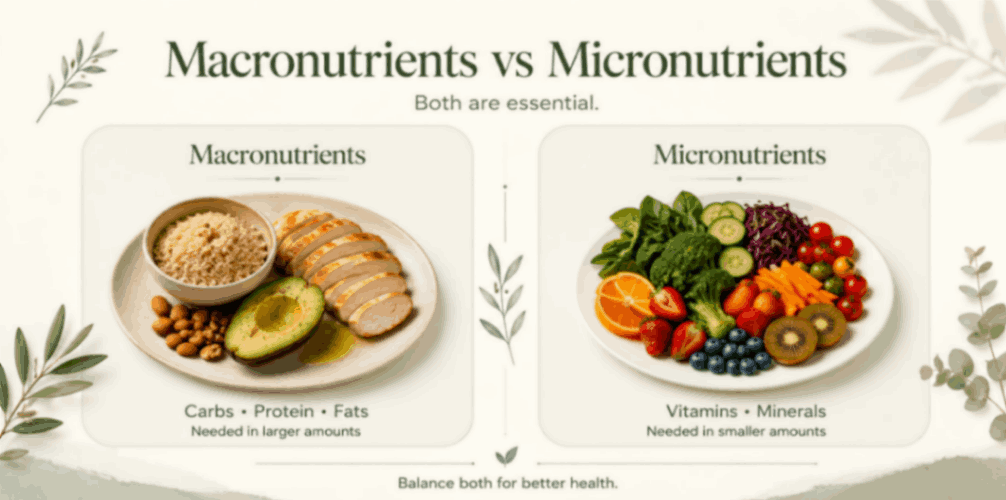
Macronutrients vs Micronutrients
| Nutrient Group | Examples | Main Role |
|---|---|---|
| Macronutrients | Protein, carbohydrates, fats | Energy, structure and essential physiological functions |
| Micronutrients | Iron, calcium, magnesium, zinc, vitamins D and B12 | Support numerous metabolic and physiological processes |
Why “Perfect Macro Ratios” Are Not the Answer
Rules such as “50% carbohydrates, 30% protein and 20% fat” may look scientific because they contain numbers, but they are not universal formulas. An endurance athlete, an older adult and someone with a sedentary lifestyle may all need different approaches.
Protein
Provides amino acids used in tissues and functional molecules.
Indian options: dal, pulses, tofu, soy, curd, paneer, eggs, fish, poultry, nuts and seeds.
Carbohydrates
An important energy source where food quality matters.
Think: whole grains, fruits, vegetables, pulses, rice, roti, millets and oats.
Fats
Dietary fat is essential, but fat quality also matters.
Think: nuts, seeds and suitable unsaturated oils within a varied diet.
“The mistake is not caring about micronutrients. The mistake is optimising individual nutrients while the overall diet is still poorly structured.”
So Where Do Vitamins and Minerals Fit?
Iron, calcium, magnesium, zinc, vitamin D, vitamin B12 and other micronutrients are not optional details. Deficiencies can matter even when calorie intake appears adequate.
But the solution is not automatically a separate supplement for every nutrient. Dietary variety across fruits, vegetables, pulses, grains, nuts, seeds and protein foods can help improve overall micronutrient coverage. India’s ICMR-National Institute of Nutrition also places healthy dietary patterns at the centre of its Dietary Guidelines for Indians.
The Common Mistake: Building Nutrition Backwards
Imagine taking several supplements while regularly missing meals, eating little protein and rarely including fruit or vegetables. The details are being optimised before the foundation.
Eat Enough
Match food intake appropriately to your needs.
Build Meals
Include protein, quality carbohydrates, produce and suitable fats.
Create Variety
Rotate foods instead of eating the same few items every day.
Find Real Gaps
Consider diet, life stage, health conditions and confirmed deficiencies.
Supplement Purposefully
Use supplements to complement—not replace—the diet.
Can a Multivitamin Cover a Poor Diet?
What It Can Do
A multivitamin may help increase vitamin and mineral intake when dietary intake is insufficient.
What It Cannot Do
It cannot replace a varied diet that also provides fibre and numerous other beneficial food components.
A Simpler Way to Build Your Plate
✓ Where is my protein?
Dal, paneer, soy, curd, eggs, fish, meat or another suitable source.
✓ Where are my vegetables or fruit?
Choose variety instead of depending on one “superfood.”
✓ What is providing energy?
Rice, roti, millets, oats, potatoes, fruit or other suitable carbohydrate foods.
✓ Where are my healthy fats?
Nuts, seeds and suitable oils can contribute.
Frequently Asked Questions
Are macronutrients more important than micronutrients?
No. Both are essential. A healthy diet needs adequate energy and macronutrients alongside vitamins, minerals, fibre and dietary variety.
Do I need to track every vitamin and mineral?
Most healthy people do not need to manually track every micronutrient every day. Restrictive diets, deficiencies or specific health conditions may justify closer monitoring.
Will eating healthy automatically prevent every deficiency?
No. Deficiencies can still occur because of dietary restrictions, absorption problems, life stage, medical conditions or other individual factors.
Should everyone take a multivitamin?
No. Supplements can be useful in specific circumstances, but they should complement rather than replace a nutritious and varied diet.
The Bottom Line
Good nutrition is not a competition between macronutrients and micronutrients. Your body needs both.
Start with adequate food, protein, quality carbohydrates, healthy fats, fruits, vegetables and dietary variety. Then look more closely at nutrients such as calcium, iron, vitamin D, B12 or magnesium when your diet, lifestyle, health or test results give you a reason to.
Build the foundation first. Optimise the details second.
References
- World Health Organization — Healthy Diet WHO guidance on healthy diets, dietary diversity, fats, carbohydrate quality and balanced eating.
- ICMR-National Institute of Nutrition — Dietary Guidelines for Indians 2024 Official Indian dietary guidance covering balanced meals, dietary diversity and nutrient adequacy.
- NIH Office of Dietary Supplements — Multivitamin/Mineral Supplements Guidance on multivitamin and mineral supplements and their role alongside a varied diet.
- World Health Organization — Guidelines on Fats and Carbohydrates WHO recommendations covering carbohydrate quality and fruit, vegetable and naturally occurring fibre intake.