
Key Takeaways
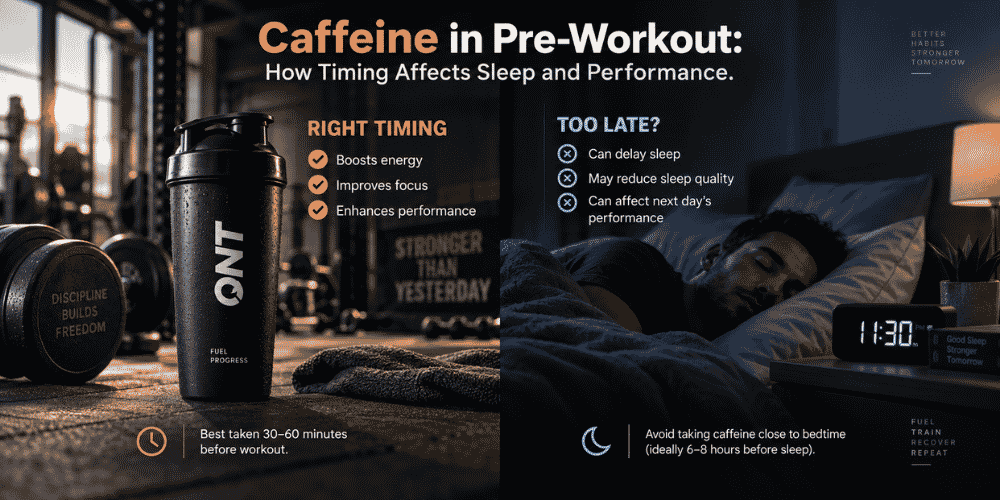
The Performance and Sleep Trade-Off
You take a pre-workout before an evening gym session, feel focused during training and complete a productive workout. Hours later, you are lying in bed feeling alert when you should be sleeping.
Caffeine can reduce perceived fatigue and improve certain types of exercise performance. The challenge is that it remains active for several hours after the noticeable stimulation begins to fade.
Taking caffeine too late may improve one workout while interfering with the sleep needed to recover for the next one.
“The best pre-workout timing supports today’s training without weakening tomorrow’s recovery.”
How Caffeine May Improve Workout Performance
Caffeine is a central nervous system stimulant. It can increase alertness and make demanding exercise feel more manageable.
When Should You Take Caffeine Before Training?
Caffeine is absorbed relatively quickly and commonly reaches peak blood concentrations within approximately 45 minutes. Sports-nutrition guidance often recommends consuming it around 15–60 minutes before exercise.
Check the label
Find the caffeine amount in one complete serving.
Time the serving
Around 30–45 minutes before training is a practical starting point.
Assess tolerance
Begin conservatively instead of immediately using the highest dose.
Check bedtime
Calculate the gap between the serving and your planned sleep time.
How Long Does Caffeine Stay in Your System?
The approximate average half-life of caffeine.
After taking 200 mg at 6:00 p.m., a considerable amount may still be active at 10:00 or 11:00 p.m. You may feel that the stimulation has worn off while caffeine is still affecting sleep.
How Late Pre-Workout Can Affect Sleep
Caffeine may make it harder to fall asleep, shorten total sleep and reduce sleep efficiency. The effect depends on the dose, timing and individual sensitivity.
Shorter sleep
A meta-analysis found an average reduction of approximately 45 minutes in total sleep.
Delayed sleep onset
The same analysis found that falling asleep was delayed by around nine minutes on average.
Reduced deep sleep
Sleep quality may be affected even when a person still manages to fall asleep.
What Is a Sensible Caffeine Cut-Off?
For many people, avoiding substantial caffeine for at least six to eight hours before bedtime is a reasonable starting point. Sensitive users or those taking a high-stimulant formula may need a longer gap.
| Planned training time | Practical caffeine approach |
|---|---|
| Morning | A caffeinated pre-workout may fit comfortably. |
| Early afternoon | Usually easier to separate from bedtime. |
| Late afternoon | Consider the dose, bedtime and personal sensitivity. |
| Evening | Choose a lower-caffeine or stimulant-free option. |
| Close to bedtime | Avoid caffeinated pre-workout. |
Can You Sleep Normally and Still Be Affected?
Yes. Falling asleep does not prove that caffeine had no effect. It may reduce sleep depth, increase brief awakenings or shorten total sleep without making the disruption obvious.
Using caffeine to compensate for caffeine-related sleep loss can create a repeating cycle of fatigue, higher stimulant intake and weaker recovery.
How to Use Pre-Workout Without Ruining Sleep
Count every caffeine source
Include pre-workout, coffee, tea, energy drinks and other supplements.
Use the lowest useful amount
A smaller serving may provide focus with fewer unwanted effects.
Reserve it for key sessions
A stimulant may not be necessary before every workout.
Choose stimulant-free at night
Review the full label because not every pre-workout is caffeine-free.
Protect recovery
A moderate evening session may be better than strong stimulation followed by poor sleep.
Pre-Workout and Sleep Checklist
Optional QNT Pre-Workout Recommendation
QNT Hydravol Pre-Workout Powder
QNT Hydravol is one caffeinated pre-workout option for adults who train earlier in the day and want caffeine alongside other performance-focused ingredients.
This is a product-fit recommendation, not a claim that a caffeinated pre-workout is necessary or suitable for everyone. Review the exact pack for caffeine per serving, directions, ingredients and warnings.
Frequently Asked Questions
How long before a workout should I take caffeine?
Around 15–60 minutes before exercise is commonly recommended. The most suitable timing depends on the product form, meal timing and individual response.
How late is too late for pre-workout?
For many people, caffeinated pre-workout within six to eight hours of bedtime may disrupt sleep. Higher doses or greater sensitivity may require a longer gap.
Can I take pre-workout at 6 p.m.?
One disturbed night does not erase a workout, but consistently poor sleep may reduce recovery, readiness and future training quality.
Final Word
Caffeine can improve alertness and support certain types of exercise performance, but timing determines whether it helps or interferes with recovery.
Take caffeinated pre-workout early enough that it does not compromise bedtime. Check the dose, calculate caffeine from every source and use the smallest amount that provides a useful effect.
A productive workout matters, but so does the sleep that allows you to recover and perform again.