Dumbbells vs Barbells vs Machines: Which Is Best for Building Muscle?
Compare dumbbells, barbells and resistance machines for muscle growth, strength, stability and exercise control—and learn how to combine all three in a practical training programme.
Key takeaways
Why training equipment evolved
Early physical-culture athletes relied mainly on free weights, bodyweight movements and basic lifting exercises. As bodybuilding developed, the emphasis shifted from simply demonstrating strength to building muscular size, symmetry and definition.
Weightlifting, powerlifting and bodybuilding eventually developed different goals. Olympic weightlifting focused on explosive technique, powerlifting on maximum strength and bodybuilding on muscular tension, proportion and appearance.
This is why modern gyms offer barbells, dumbbells and machines. Each tool changes the relationship between load, stability, technique and muscular focus.
“The best training tool is not universally the heaviest one—it is the one that fits the exercise, the athlete and the intended result.”
Why different training tools exist
Olympic weightlifting
Uses specialised barbell movements to develop speed, power and technical skill.
Powerlifting
Centres on maximum strength in the squat, bench press and deadlift.
Bodybuilding
Uses resistance to create muscular tension and develop size, proportion and definition.
Dumbbells vs barbells vs machines
| Training tool | Main advantage | Main limitation | Best suited to |
|---|---|---|---|
| Barbells | Allow relatively heavy loading and simple progression. | Require technique, stabilisation and a shared movement path. | Compound strength exercises. |
| Dumbbells | Train each side independently with greater movement freedom. | Balance, grip or setup may limit heavy sets. | Unilateral work and flexible joint positions. |
| Machines | Provide external stability and targeted muscular focus. | The fixed path may not suit every body or joint structure. | Controlled hypertrophy work and fatigue management. |
How barbells work
A barbell connects both hands or both sides of the body to one shared load. Because the two sides work together, barbells usually allow more total weight than comparable dumbbell exercises.
Advantages
- Relatively heavy loading
- Effective compound exercises
- Measurable progressive overload
- Coordination between muscle groups
- Small, gradual weight increases
- Strong application to strength training
Limitations
- The stronger side may compensate for the weaker side
- Fixed hand positions may feel uncomfortable
- Heavy sets require strong technical control
- Fatigue can reduce movement quality
- Joint and connective-tissue stress may rise with poor form
Common barbell exercises
How dumbbells work
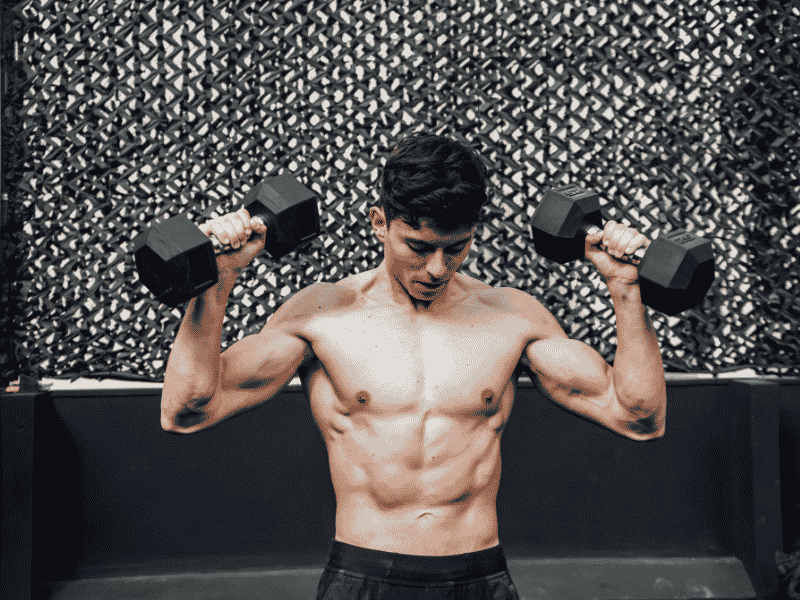
Dumbbells allow each arm or leg to move independently. During a dumbbell press, each side must control its own resistance, making balance, coordination and strength differences easier to notice.
Advantages
- Independent work for both sides
- Greater movement freedom
- Useful unilateral training
- Increased stabilisation demands
- Easier identification of imbalances
- Several exercise angles and joint positions
Limitations
- Heavy dumbbells may be difficult to position
- Weight jumps can make progression less gradual
- Grip or balance may limit the set
- Coordination may fail before the target muscle
- Very heavy exercises may require assistance
How resistance machines work
Machines guide resistance along a fixed or semi-fixed path. Much of the balance and movement stability is supplied by the equipment, allowing the lifter to concentrate more directly on pushing or pulling.
External stability
The machine reduces the need to balance the resistance in several directions.
Muscular focus
Greater stability can make it easier to concentrate on the target muscle, especially during fatigue.
Designed resistance
Pulleys, cables, cams and lever arms can change the challenge across the movement.
Common machine exercises
Why machine weights cannot always be compared
Saying “I lifted 400 kg on the leg press” does not provide the complete picture. The resistance experienced by the body depends on the machine’s design, setup and the lifter’s position.
Free weights versus machines
Free weights require control
Barbells and dumbbells require the lifter to manage:
- Core stability
- Joint control
- Balance
- Coordination
- Movement-path control
- Technical awareness
Machines support muscular focus
Greater stability can make it easier to concentrate on:
- Muscle contraction
- Controlled repetitions
- Full range of motion
- Slower lowering phases
- Training close to muscular failure
- Maintaining tension during fatigue
Is resistance constant on machines?
Exercise difficulty is influenced by gravity, leverage and joint position. With free weights, gravity pulls vertically, but the challenge changes as the relationship between the load and the joints changes.
A dumbbell lateral raise, for example, is usually easier near the bottom and harder as the arm approaches horizontal. The dumbbell has not become heavier—the lever arm has changed.
Free-weight resistance
The challenge changes naturally according to gravity, body position and joint leverage.
Machine resistance
Cams, cables and pulleys can make resistance smoother or change where an exercise feels hardest.
Machines do not always create perfectly constant tension, but many can provide a more controlled resistance profile than a simple free-weight movement.
Which is better for muscle growth?
Muscles respond to training tension, appropriate volume, progressive overload and adequate recovery. They do not identify whether the resistance came from a barbell, dumbbell or machine.
Training around injuries or limitations
Machines may be useful when a person is managing an injury or cannot safely stabilise a free weight. A chest press machine, for example, may be easier to control than heavy dumbbells.
A supported row may also reduce lower-back involvement compared with a bent-over barbell row.
Injury-related exercise selection should be based on professional guidance, pain-free movement and gradual progression.
How to combine all three
A practical training session can use each tool for the role it performs best.
Begin with a compound movement
Use a barbell or heavy machine while concentration and energy are highest.
Examples: squat, bench press, Romanian deadlift, hack squat or leg press.Add dumbbell exercises
Train both sides independently through a comfortable movement path.
Examples: incline press, split squat, one-arm row or walking lunge.Finish with machines or cables
Use greater stability to continue targeting muscles as overall fatigue increases.
Examples: leg extension, cable fly, lat pulldown or machine row.Should you constantly change exercises?
Exercise variety can be useful, but random changes are not always productive. A muscle does not need to be “shocked” during every session.
Progress requires enough consistency to improve technique, add repetitions and increase resistance.
The objective is planned variation—not replacing exercises so frequently that progress cannot be measured.
Frequently asked questions
Are machines as effective as free weights for muscle growth?
Machines can build muscle when they provide an appropriate range of motion, sufficient effort and progressive overload. They are not automatically inferior to free weights.
Are barbells better than dumbbells?
Barbells generally allow heavier loading, while dumbbells provide independent movement and greater freedom. The better option depends on the exercise and goal.
Do dumbbells activate more stabilising muscles?
Dumbbells usually require greater independent control and stabilisation, but that does not automatically mean they provide a better stimulus to the target muscle.
Why can I leg press more than I can squat?
The leg press provides external stability and uses different body positions, leverages and machine mechanics. The two numbers are not directly comparable.
Are machines safer for beginners?
Machines can simplify balance and movement control, but setup and technique still matter. A machine’s fixed path may not suit every person.
Should I use all three in one workout?
You can combine them by beginning with a compound exercise, adding dumbbell work and finishing with stable machine or cable exercises.
Final word
There is no universal winner between dumbbells, barbells and machines. Barbells support heavy compound training, dumbbells improve independent control and machines provide stability for targeted muscular work.
The correct choice depends on your goal, experience, mobility, injury history and the purpose of the exercise.
The most effective tool is not always the one that displays the largest weight. It is the one that helps the intended muscles work hard while allowing you to train consistently, progressively and safely.
Editorial reference points
- Exercise selection should match the athlete’s goal, experience, mobility and physical condition.
- Machine weight displays should primarily be used to track progress on the same machine and setup.
- Muscle development depends on sufficient tension, progressive overload, suitable training volume and recovery.
- Exercise variety should be planned rather than changed randomly before progress can be evaluated.