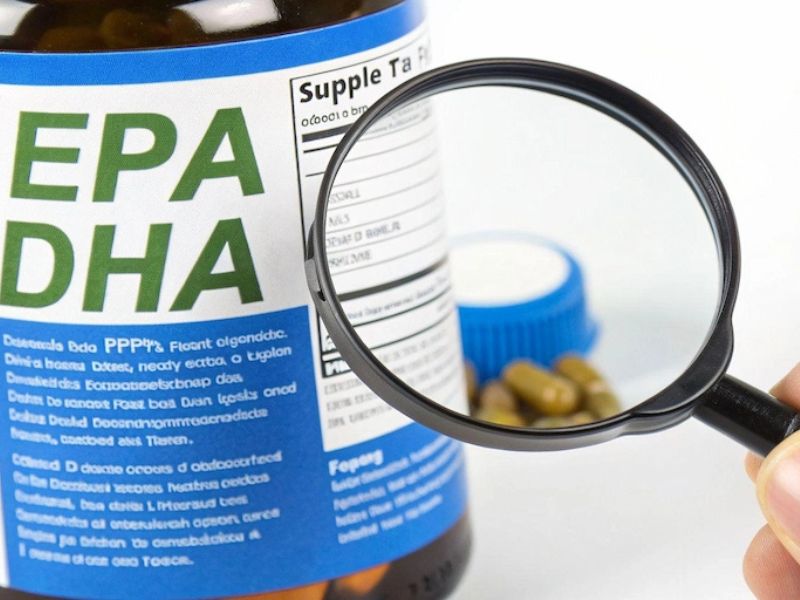
Are You Taking the Best Omega-3 Supplement in India?
Look beyond the fish-oil number. Compare EPA and DHA, quality evidence, serving sizes and value to choose an omega-3 supplement that suits your needs.
Two Bottles. Similar Promises. Different Nutritional Value.
Imagine comparing two supplement labels. Both display 1,000 mg in bold and promise quality. Yet that headline number might tell you surprisingly little about how much EPA and DHA you will actually get.
Before deciding which is the best omega-3 supplement in India, look at the fatty acids inside, the evidence behind quality claims and the amount provided in each serving. Those details are more useful than impressive packaging.

Start With EPA and DHA, Not the Fish-Oil Number
EPA (eicosapentaenoic acid) and DHA (docosahexaenoic acid) are long-chain omega-3 fatty acids found in fish and certain other marine sources. Their amounts are more useful for comparing fish-oil supplements than total oil weight alone.
| Label component | Amount |
|---|---|
| Total fish oil | 1,000 mg |
| EPA | 180 mg |
| DHA | 120 mg |
| Combined EPA + DHA | 300 mg |
Although this capsule contains 1,000 mg of fish oil, it supplies 300 mg of combined EPA and DHA. Formulations vary: a larger fish-oil number does not necessarily mean more EPA and DHA. Always compare the actual label and serving size.
How Do You Choose a High-Quality Omega-3 Supplement?
Potency is only one part of the decision. Review these five areas before purchasing.
1. EPA and DHA Content
Check the milligrams of each fatty acid per serving; “high strength” needs supporting figures.
2. Purity and Contaminants
Look for specific quality-control information about relevant environmental contaminants, beyond words such as “pure” or “premium.”
3. Freshness and Oxidation
Ask about oxidation control; assessments may include peroxide value (PV), p-anisidine value (pAV) and total oxidation value (TOTOX).
4. Testing and Transparency
Check whether the laboratory, testing scope and results are verifiable; a badge alone does not prove independent testing of every batch.
5. Form and Ingredients
Review the form, ingredients and directions; triglyceride or ethyl-ester form alone does not determine overall quality.
GOED describes voluntary industry quality parameters. Labels may not display every result, so ask whether supporting documentation is available. If batch-specific verification matters to you, seek documentation linked to that product or batch.
Research suggests absorption can vary with formulation and how a supplement is taken. Consider the whole product rather than judging quality by its form alone.
Read an Omega-3 Label in This Order
- 01 — Serving Size
Does the stated amount apply to one softgel or multiple capsules?
- 02 — EPA and DHA
How many milligrams of each do you receive per serving?
- 03 — Source
Is the source clearly identified as fish oil, algal oil or something else?
- 04 — Quality Information
Are purity, oxidation-control and testing claims explained and supported?
- 05 — Directions and Storage
Are serving instructions, storage requirements and relevant warnings clear?
- 06 — Comparable Cost
What does a similar amount of combined EPA and DHA cost across products?
How Much EPA and DHA Should a Supplement Contain?
There is no single EPA + DHA dose that is right for every adult. Your needs depend on your diet, health status, reason for supplementation and professional advice.
Fish and seafood can provide EPA and DHA through food. Supplements may be useful for people who do not regularly eat these foods, but benefits vary by outcome and individual circumstances.
Choose an Omega-3 Supplement for Your Needs
The most suitable option depends on your priorities and what the product can substantiate.
| Your priority | What to look for |
|---|---|
| Everyday nutritional support | Clearly stated EPA and DHA amounts, straightforward directions and credible quality information. |
| Higher potency | More EPA and DHA per serving, with an appropriate serving size and a price that makes sense for you. |
| Active lifestyle | Transparent composition and a fit with your diet and routine; do not assume supplements automatically improve performance. |
| Vegetarian or vegan diet | Algal oil with clearly stated DHA and, where available, EPA. |
| Value-conscious buying | Comparable EPA + DHA amounts, transparent quality information and cost for a comparable quantity. |
Certain algae-derived products supply DHA, and some also supply EPA. Flaxseed oil supplies ALA, a different omega-3 fatty acid that the body converts to EPA and DHA only to a limited extent. Check the exact composition rather than treating all omega-3 sources as interchangeable.
“The most suitable omega-3 supplement is one that fits your needs and provides information you can verify.”
Where Does QNT Omega-3 Fish Oil Fit?
QNT Omega-3 Fish Oil, 60 Softgels is one option to assess using the same criteria. The QNT India listing states the following amounts per softgel:
1,000 mgTotal fish oil
180 mgEPA
120 mgDHA
300 mgCombined EPA + DHA
The listing describes the product as Nordic fish oil and mentions molecular distillation. Compare its stated composition with other products, then assess purity information, testing evidence, ingredients, directions and price.
A product-page description alone does not prove independent, batch-specific testing or establish that a product is the best choice for everyone. Review the current packaging and product information before purchasing, since formulations and listings can change.
Your Five-Minute Omega-3 Buying Checklist
- Have I checked EPA and DHA separately?
- Am I comparing the same serving size?
- Is meaningful purity and oxidation information available?
- Are testing claims specific and verifiable?
- Have I compared costs for equivalent EPA + DHA amounts?
- Does the source suit my dietary preferences?
- Do I need professional advice before taking it?
If you cannot answer several of these questions, pause before buying. Compare the labels and supporting information rather than relying on front-of-bottle claims.
Frequently Asked Questions
What makes an omega-3 supplement high quality?
It should clearly state EPA and DHA content, identify its source, provide appropriate serving and storage instructions, and offer credible information about purity and oxidation control. Verifiable testing documentation can strengthen confidence.
Is 1,000 mg of fish oil enough per day?
Total fish-oil weight alone cannot answer that question. Check how much EPA and DHA the serving supplies. Appropriate intake depends on your diet and individual circumstances.
Are high-strength omega-3 capsules always better?
No. Higher potency may supply more EPA and DHA per serving, but it is not automatically necessary or suitable for everyone. Consider composition, directions, quality evidence and your actual needs.
Can vegetarians take omega-3 supplements?
Yes. Algal-oil supplements are an option for people avoiding fish. Products vary in whether they supply DHA alone or both DHA and EPA, so check the label.
Should I consult a doctor before taking omega-3?
Professional advice is particularly important if you have a medical condition, take medicines such as anticoagulants or intend to take high doses. Supplements should not replace prescribed treatment or an appropriate diet.
References
- National Institutes of Health, Office of Dietary Supplements — Omega-3 Fatty Acids: Fact Sheet for Health Professionals.
- Global Organization for EPA and DHA Omega-3s — GOED Voluntary Monograph.
- National Center for Complementary and Integrative Health — Omega-3 Supplements: What You Need to Know.
- Food Safety and Standards Authority of India — Codex Standard for Fish Oils.