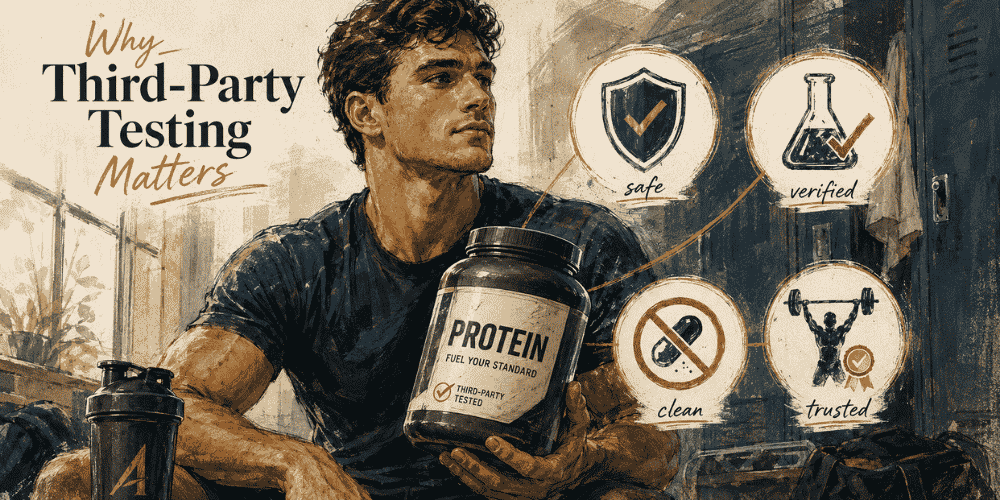
Why Third-Party Testing Matters for Athletes
Third-party testing can help athletes reduce the risk of accidentally consuming prohibited substances—but certification should be understood, verified and never treated as a 100% guarantee.
Key Takeaways
The Simple Answer
If you are an athlete using protein powder, creatine, pre-workout or another sports supplement, third-party testing can help reduce the risk of accidentally consuming prohibited substances.
The important word is reduce. NADA India warns that athletes remain responsible for prohibited substances found in their bodies and recommends reliable batch-tested supplements as one way to minimise risk.
“A testing logo is not the end of the verification process. Athletes should understand what was tested, who tested it and whether their exact batch was covered.”
What Does Third-Party Testing Mean?
Third-party testing means an organisation independent of the supplement brand evaluates the product. However, testing and certification are not necessarily the same thing.
Testing the actual supplement.
Reviewing how products are produced.
Assessing ingredients for potential concerns.
Reviewing relevant quality procedures.
Checking product information and tracking.
Some programmes include repeated or batch-level testing.
Why Banned-Substance Screening Matters
A supplement may contain a prohibited substance even when it is not intentionally highlighted on the label.
Does Certification Guarantee a Supplement Is Safe?
No. Third-party certification is a risk-reduction tool, not a 100% guarantee.
USADA notes that certification programmes cannot test for every possible prohibited substance. Certification can therefore reduce risk without eliminating every possibility.
WADA and USADA do not certify or endorse individual dietary supplements.
What Does Certification Scope Mean?
Different certification programmes may check different things. Athletes should understand exactly what a programme covers rather than judging a product only by the presence of a logo.
| Programme | Examples of Scope Mentioned |
|---|---|
| NSF Certified for Sport | Manufacturing review, ongoing monitoring and production-lot testing for a panel of banned substances. |
| Informed Sport | Ingredient and manufacturing review, pre-certification testing, post-certification testing and certified batch/flavour testing. |
“Do not ask only, ‘Does this product have a logo?’ Ask, ‘What exactly does this certification cover?’”
Why Batch Testing Is Important
Products are manufactured in batches or lots. Two tubs with the same product name may therefore come from different production runs.
USADA advises athletes to verify batch information through the certifier's official database rather than relying only on a certification logo on packaging.
What Should Indian Athletes Check?
NADA India recommends a food-first approach and advises athletes who choose supplements to consider reliable batch-tested products. Its guidance references programmes including CoE-NSTS, Informed Sport and Certified for Sport.
QNT Tip
Frequently Asked Questions
Final Answer
Third-party testing for athletes matters because supplement quality cannot be judged from marketing claims alone.
A meaningful programme should explain what is tested, how products are reviewed and whether individual batches can be verified.
“Need the supplement → check the ingredients → understand the certification → verify the batch → keep records.”
References
- NADA India guidance on supplements, strict liability and athlete anti-doping responsibility.
- USADA guidance on reducing supplement risk and verifying third-party certification.
- NSF Certified for Sport information on manufacturing review, monitoring and banned-substance testing.
- Informed Sport information on certification, ingredient review and batch-level testing.