
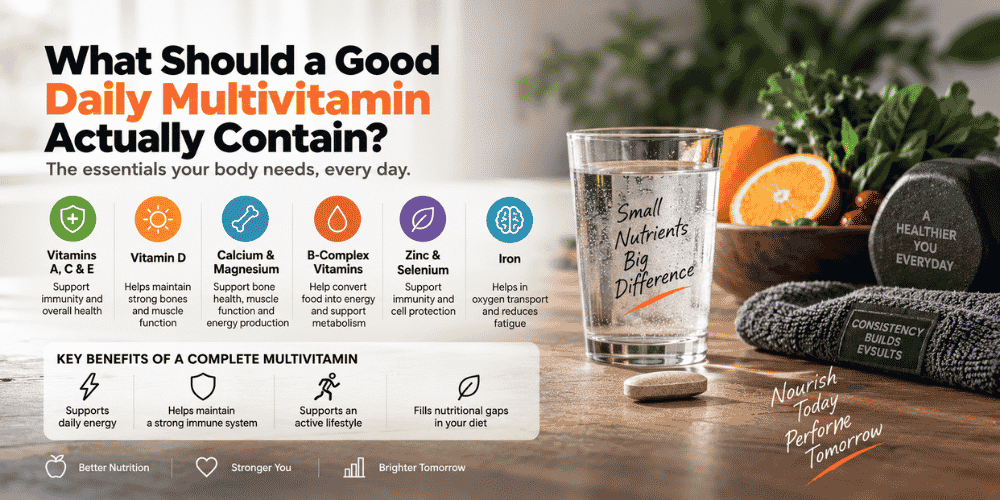
More Ingredients Do Not Automatically Mean Better
A multivitamin can contain 30 nutrients and still be poorly designed. The real quality is hidden in details such as which nutrients are included, their forms, how much you actually get and whether those choices make sense together.
There is no universal formula that is perfect for everyone. Age, diet, life stage and existing nutrient intake can all influence what someone may need. A daily multivitamin is best viewed as a way to help fill nutritional gaps—not as a replacement for eating well.
Key Takeaways
The Ingredient Count Is the Least Interesting Part
The first thing a multivitamin label often wants you to notice is the number: twenty nutrients, thirty nutrients or even more.
But a nutrient only deserves space on the label if it serves a purpose. Multivitamin ingredients should be evaluated for relevance, dosage and form, not counted like points on a scoreboard.
The Form on the Label Tells You More Than the Marketing Copy
Two multivitamins can list the same nutrient while using different forms. That makes form worth checking—but the most technical-sounding option is not automatically the best.
Vitamin B12
Labels may use methylcobalamin or cyanocobalamin. Methylcobalamin is a form used in the body, while cyanocobalamin is converted into active forms. Current NIH guidance does not establish one supplemental form as universally better absorbed.
Folate
Folate may appear as folic acid or forms such as 5-MTHF. Which one makes sense depends on context and the intended user rather than which name sounds more advanced.
Vitamin D
Both vitamin D2 and D3 can increase vitamin D levels, while D3 generally produces a greater and more sustained increase in blood 25-hydroxyvitamin D.
Why “More” Can Be the Wrong Goal
A label showing 500% or 1,000% of a nutrient's Daily Value can make a product look stronger. But a larger percentage does not automatically make a dose more useful.
Even 100% of the RDA or NRV is not a universal magic number. Some nutrients may reasonably sit below it, while others may be higher depending on the formula and intended audience. The better question is whether the dose is purposeful.
How to Read a Multivitamin Label Without Getting Lost
Treat the label like a five-minute investigation. Start with serving size, then move through the formula systematically.
Serving Size
Check how many tablets or capsules make up one serving.
Actual Amounts
Read the amount of each nutrient, not only the percentage beside it.
Nutrient Forms
Check how each vitamin and mineral is provided.
Nutrient Overlap
Consider what you already get from fortified foods or other supplements.
Quality Assurance
Review manufacturing standards, testing and independent verification.
Five Questions Worth Asking About the Formula
Quality Assurance Matters Too
Independent verification can provide useful additional confidence because supplement quality involves more than simply reading the ingredient panel.
A quality mark does not automatically make one product the best multivitamin, but independent testing can provide another useful piece of evidence when comparing similar products.
Are Expensive Multivitamins Actually Better?
Not necessarily. A higher price might reflect ingredient sourcing, manufacturing controls, testing or packaging. It might also reflect branding.
| Less Useful Comparison | Smarter Comparison |
|---|---|
| Total ingredient count | Relevance, dose and nutrient form |
| Huge Daily Value percentages | Purposeful dosage balance |
| Premium price alone | Formula, transparency and manufacturing standards |
| Marketing language | Testing, label clarity and personal fit |
Where QNT Daily Vitamins Fits Into the Comparison
Evaluate the Label, Not Just the Ingredient Count
QNT's Daily Vitamins category is positioned around everyday vitamin and mineral support. Rather than treating the number of ingredients as the main selling point, compare the actual QNT label against the same criteria used for any multivitamin.
Check nutrient forms, amounts, mineral coverage, serving size, potential overlap with other supplements and whether the formula fits your own nutritional needs.
Your Diet Still Comes First
A multivitamin cannot reproduce everything food provides. Whole foods deliver protein, fibre, essential fats and a wider range of naturally occurring compounds alongside vitamins and minerals.
NIH specifically notes that multivitamin/mineral supplements cannot replace eating a variety of foods. The useful question is whether a well-formulated supplement can sensibly fill a nutritional gap that remains.
The 10-Point Multivitamin Buying Checklist
Frequently Asked Questions
The Bottom Line
A multivitamin does not become better every time another ingredient gets added. A thoughtful formula is one where you can understand why the nutrients are included, why they are provided in those amounts and whether they make sense for the person taking them.
That is a better way to judge multivitamin quality than counting ingredients, chasing enormous percentages or assuming a more expensive bottle must be superior.