Why Take L-Carnitine?
Understand what L-carnitine does in the body, whether it supports fat loss or exercise performance, where it is found and when supplementation may be useful.
Key Takeaways
Introduction
L-carnitine has been promoted for decades as a supplement for fat metabolism, workout energy and physical performance. Its biological role is genuine, but many commercial claims go beyond what research has established.
Your body naturally produces L-carnitine, and it is also present in food—particularly meat and dairy products. For most healthy people, this combination provides enough to support normal body functions. 1
The practical question is therefore not whether L-carnitine is important, but whether taking more through a supplement produces a meaningful additional benefit.
1. What Is L-Carnitine?
L-carnitine is a water-soluble, vitamin-like compound derived from the amino acids lysine and methionine. It is not technically an amino acid, even though amino acids are required for its production.
Most internal synthesis takes place in the liver and kidneys. Carnitine is then transported to tissues such as skeletal and cardiac muscle, where large amounts are stored. 1 2
2. How Does L-Carnitine Work?
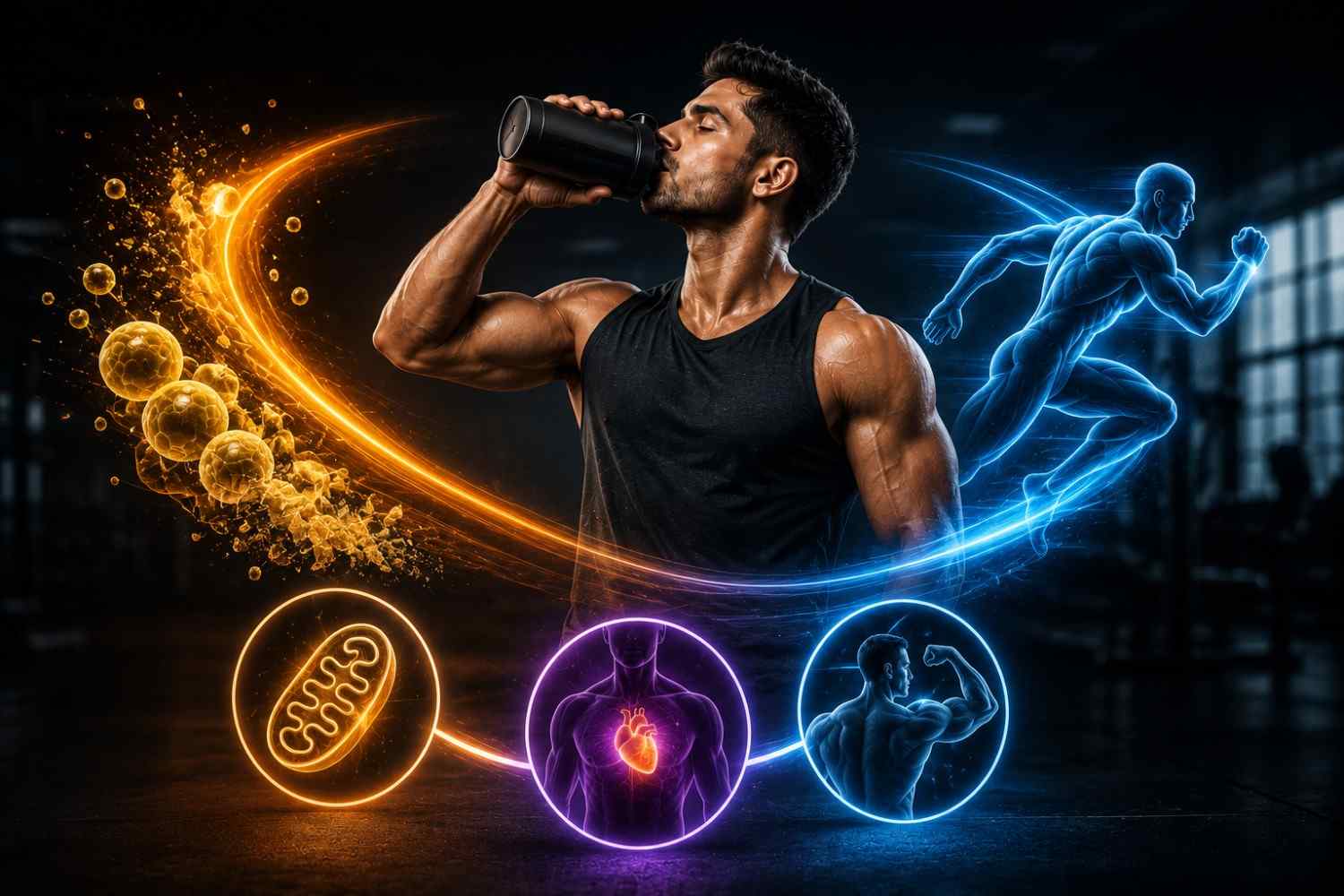
L-carnitine is an essential part of the carnitine shuttle, a system that helps move long-chain fatty acids into mitochondria. Mitochondria can then oxidise those fatty acids and use the resulting products in energy production. 2
Nutrients Involved in Natural Production
L-carnitine synthesis involves several nutrients and enzymes. A varied diet normally supplies these components without requiring a specialised carnitine-focused meal plan.
3. L-Carnitine and Acetyl-L-Carnitine
Carnitine supplements are sold in several forms. They are related but should not be treated as identical products with interchangeable evidence.
| Form | Description | Common Research Area |
|---|---|---|
| L-Carnitine | The standard form commonly used in general and sports supplements. | Deficiency, metabolism, exercise and body composition |
| L-Carnitine L-Tartrate | L-carnitine combined with tartaric acid and frequently used in sports products. | Exercise recovery and muscle-damage markers |
| Acetyl-L-Carnitine | An acetylated carnitine derivative with different biological characteristics. | Neurological and cognitive conditions |
| Propionyl-L-Carnitine | A propionyl derivative studied in specific circulatory and clinical contexts. | Peripheral circulation and selected medical conditions |
4. Does L-Carnitine Help With Weight Loss?
Because L-carnitine participates in fatty-acid transport, it is frequently advertised as a fat burner. That description oversimplifies how fat loss occurs.
Meta-analyses of clinical trials have found small average reductions in body weight, body mass index or fat mass in some groups, particularly adults with overweight or obesity. However, results vary considerably, and the average effect is modest rather than transformational. 3
“L-carnitine helps the body process fatty acids, but it does not make fat disappear without a suitable diet and active lifestyle.”
5. Can It Improve Exercise Performance?
The idea is attractive: increasing muscle carnitine could theoretically support fatty-acid use, preserve glycogen and delay fatigue. In practice, increasing muscle carnitine through oral supplementation is difficult because absorption and muscle uptake are limited.
Reviews of human studies report mixed results. Acute supplementation does not consistently improve exercise performance, while some longer-term protocols have produced benefits under specific conditions. The results cannot be generalised to every athlete, workout or product. 4 5
| Outcome | Evidence Summary |
|---|---|
| Immediate Workout Energy | A single serving is unlikely to work like a stimulant or pre-workout energy booster. |
| Endurance Performance | Findings are inconsistent, and many studies show no significant improvement. |
| High-Intensity Performance | Some longer-term studies report benefits, but protocols and findings differ. |
| Exercise Recovery | Some evidence suggests reductions in muscle soreness and selected muscle-damage markers. |
6. L-Carnitine and Exercise Recovery
The recovery evidence may be more promising than claims of immediate workout enhancement. A systematic review and meta-analysis reported improvements in delayed-onset muscle soreness and certain markers of exercise-induced muscle damage. 6
Benefits appeared more consistently in resistance-training studies and untrained participants. More research is needed to determine which athletes benefit, which form works best and how meaningful the effect is in real training programmes.
7. Who Can Develop L-Carnitine Deficiency?
True carnitine deficiency is uncommon in healthy adults. It can occur because of rare genetic transporter disorders or as a secondary effect of certain diseases, medical treatments, severe malnutrition or medication use. 2
8. Where Is L-Carnitine Found?
Animal-derived foods provide substantially more carnitine than most plant foods. Red meat is the richest common dietary source, followed by other meats, fish and dairy products. 1
| Food Group | Examples | Relative Amount |
|---|---|---|
| Red Meat | Beef, lamb and pork | Highest among common foods |
| Other Animal Foods | Fish and poultry | Moderate to lower amounts |
| Dairy Products | Milk and cheese | Smaller but meaningful amounts |
| Plant Foods | Tempeh, avocado, nuts and cereals | Generally very low amounts |
Food Versus Supplement Absorption
Lower absorption does not mean a supplement is useless, but it helps explain why swallowing a large dose does not necessarily create an equally large increase inside muscle tissue. 7
9. How Much L-Carnitine Do You Need?
There is no established Recommended Dietary Allowance for carnitine. Healthy children and adults generally synthesise enough to meet normal physiological needs. 1
Amounts used in research and commercial products vary widely. A clinical dose used for a diagnosed deficiency is not the same as a general sports-supplement serving and should never be copied without medical supervision.
10. Side Effects and Safety
L-carnitine is generally tolerated at common supplemental amounts, but higher intakes can cause digestive side effects. The NIH notes that intakes of approximately 3 g or more per day may cause nausea, vomiting, abdominal cramps, diarrhoea and a fishy body odour. 1
L-Carnitine Buying Checklist
- Identify the exact form of carnitine.
- Check the amount per serving.
- Review all additional ingredients.
- Avoid guaranteed fat-loss claims.
- Choose a reputable, clearly labelled product.
- Follow the product directions.
- Do not combine multiple carnitine products unknowingly.
- Stop use if significant side effects develop.
- Assess results over a realistic period.
- Keep training and nutrition as the foundation.
- Look for independent quality testing.
- Check relevant anti-doping certification.
- Avoid proprietary blends with hidden amounts.
- Do not expect stimulant-like energy.
- Track performance rather than relying on perception.
Evidence Summary
What Should You Take Away From This?
L-carnitine performs a vital function inside the body, but its essential biological role should not be confused with a guaranteed benefit from taking additional amounts.
It is not a miracle fat burner and does not replace a suitable calorie intake, regular activity or consistent training. Research suggests that any weight-management effect is likely to be modest.
Some people may find L-carnitine useful for convenience or selected recovery goals, while people with diagnosed deficiencies may require it medically. For most healthy adults, the decision should be based on realistic expectations, product quality, tolerance and individual need.
Frequently Asked Questions
Is L-carnitine an amino acid?
No. It is a water-soluble compound that the body synthesises using the amino acids lysine and methionine.
Does L-carnitine burn belly fat?
It cannot target belly fat or force the body to lose fat from a particular area. Any fat loss still depends on overall energy balance and sustained lifestyle habits.
Does L-carnitine provide immediate energy?
It is involved in cellular energy metabolism but does not work like caffeine. A single serving is unlikely to create a noticeable stimulant effect.
Should L-carnitine be taken before a workout?
Timing is less important than the overall supplementation protocol. Many proposed effects have been studied after repeated use rather than a single pre-workout serving.
Do vegetarians and vegans need L-carnitine supplements?
Not automatically. Although dietary intake is lower, healthy people can synthesise carnitine and conserve it efficiently. Supplementation should be based on individual needs rather than diet labels alone.
Is acetyl-L-carnitine better than L-carnitine?
Neither form is universally better. They have different characteristics and have been studied for different purposes, so the most appropriate form depends on the intended use.
Can L-carnitine cause side effects?
Yes. Larger intakes may cause nausea, vomiting, abdominal cramps, diarrhoea or a fishy body odour.
References
- NIH Office of Dietary Supplements: CarnitineHealth-professional fact sheet covering carnitine synthesis, food sources, absorption, health effects and supplement safety.View Fact Sheet
- Carnitine DeficiencyStatPearls and NCBI Bookshelf review covering the carnitine shuttle, primary deficiency, secondary causes and clinical management.View Clinical Review
- L-Carnitine Supplementation and Weight LossTalenezhad N, Mohammadi M, Ramezani-Jolfaie N, et al. Systematic review and dose-response meta-analysis of clinical trials. 2020.View Research
- Acute and Chronic L-Carnitine Supplementation and Exercise PerformanceMielgo-Ayuso J, Pietrantonio L, Viribay A, et al. Systematic review of moderate- and high-intensity exercise outcomes. 2021.View Research
- The Bright and Dark Sides of L-Carnitine SupplementationSawicka AK, Renzi G, Olek RA. Systematic review examining prolonged supplementation, metabolism and physical performance. 2020.View Research
- L-Carnitine and Exercise-Induced Muscle DamageYarizadh H, Shab-Bidar S, Zamani B, et al. Systematic review and meta-analysis of muscle soreness and damage markers. 2020.View Research
- Pharmacokinetics of L-Carnitine and Acetyl-L-CarnitineRebouche CJ. Review covering dietary bioavailability, supplemental absorption and the regulation of carnitine metabolism. 2004.View Research
References were accessed on July 28, 2026. This article provides general educational information and does not replace personalised medical, dietary or sports-nutrition advice.