Food Supplements to Avoid Injury, Post-Workout Pain and Inflammation?
Learn what causes post-workout soreness, how tendon and joint pain should be managed, and which supplements may support recovery without replacing proper training or medical care.
Key Takeaways
Introduction
Intense or unfamiliar training can leave your muscles feeling tender, stiff and temporarily weaker. Mild post-workout soreness is common, but sharp, localised or progressively worsening pain may indicate an injury rather than normal recovery.
No food supplement can make poor technique, excessive training volume or inadequate recovery completely safe. Supplements may support an otherwise suitable routine, but they should not be used to hide pain or continue damaging activity.
Understanding whether pain comes from normal muscle soreness, a tendon problem or a joint injury is the first step towards choosing an appropriate response.
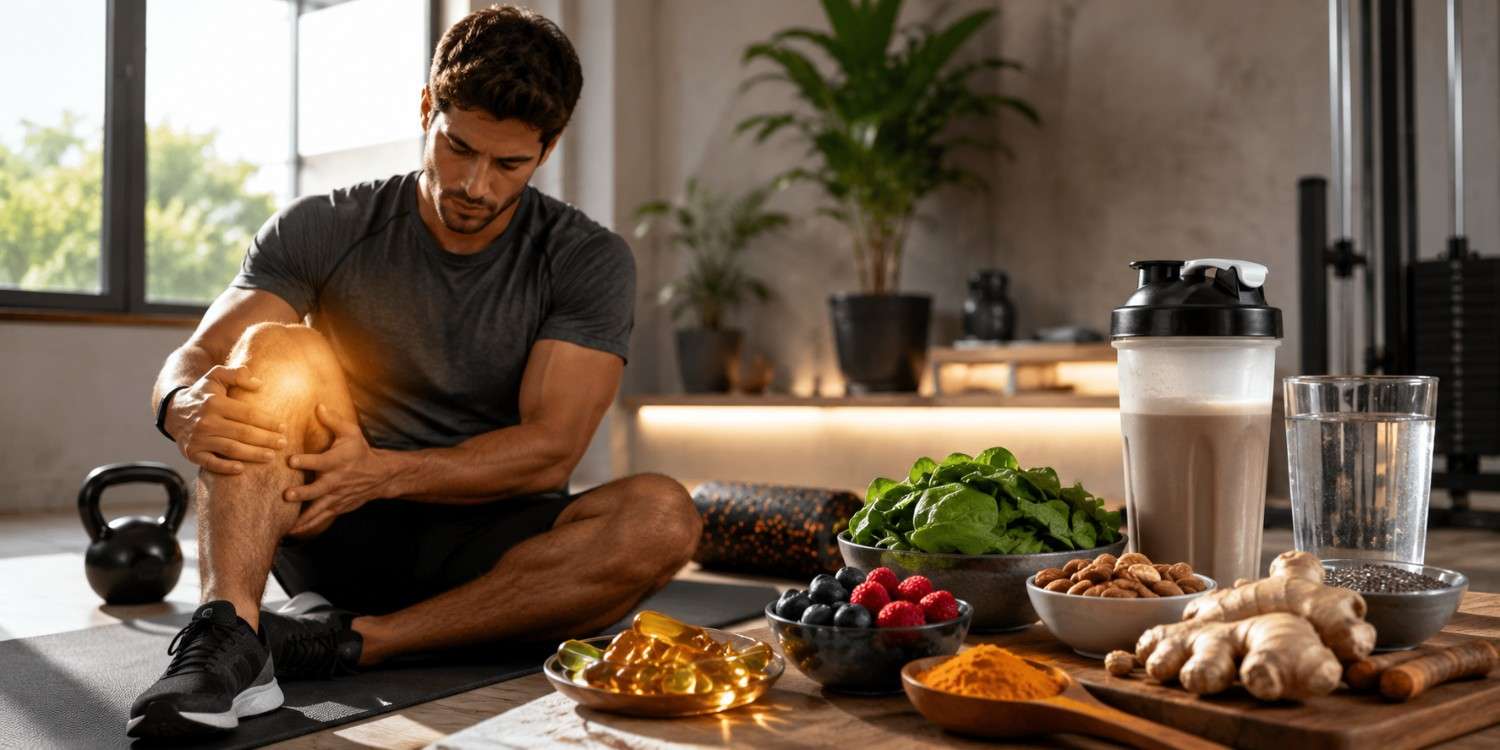
1. Why Do Muscles Hurt After Training?
Delayed-onset muscle soreness, commonly called DOMS, often develops several hours after an unfamiliar or demanding workout and may feel strongest between approximately 24 and 72 hours later.
DOMS is not caused by lactic acid remaining inside the muscles. It is associated with exercise-induced stress and microscopic muscle damage, particularly after eccentric movements in which a muscle lengthens while producing force. 1
- Appears after a demanding or unfamiliar workout
- Feels spread across the trained muscle
- May cause temporary stiffness or tenderness
- Gradually improves over several days
- Sharp or sudden pain during movement
- Significant swelling, bruising or instability
- Pain focused around a joint or tendon
- Symptoms that worsen instead of improving
2. What Helps With Normal Post-Workout Soreness?
| Method | What It May Do | Important Limitation |
|---|---|---|
| Gentle Activity | Temporarily reduce stiffness and help you feel more mobile | Should remain comfortable and low intensity |
| Stretching | Support flexibility and provide temporary comfort | Does not meaningfully prevent or reduce DOMS |
| Warm Bath or Heat | Provide comfort and reduce the feeling of stiffness | Does not repair an injured muscle or tendon |
| Cold Water or Ice | Temporarily reduce pain and soreness in selected situations | Frequent immediate use after strength training may interfere with some adaptations |
Should You Take Anti-Inflammatory Medicine After Training?
Anti-inflammatory medicines such as ibuprofen may reduce pain and swelling in appropriate situations. However, they should not automatically be taken after every demanding workout.
Non-steroidal anti-inflammatory drugs can cause stomach irritation, ulcers, bleeding, kidney problems and interactions with other medicines. A pharmacist or doctor can help determine whether a painkiller is suitable for you. 3
3. What Should You Do About Tendon Pain?
Tendons connect muscles to bones and are repeatedly loaded during running, lifting, jumping and throwing. Tendon pain may develop after a sudden increase in training, repetitive movement, unsuitable technique or insufficient recovery.
Mild tendon injuries may improve with short-term load reduction, cold therapy for comfort and gradual return to movement. Continuing heavy lifting or sport that makes the symptoms worse can delay recovery. 4
“Pain is useful information, but it must be interpreted—not ignored, feared or repeatedly hidden with medication.”
Should Every Painful Movement Be Stopped?
Sharp, sudden or escalating pain is a clear reason to stop. Rehabilitation is more individual: a physiotherapist may sometimes use carefully controlled movements that create mild, acceptable discomfort without worsening symptoms afterwards.
4. Can Joint Cartilage Rebuild Itself?
Articular cartilage has a limited natural healing capacity because it does not have the same direct blood supply as many other tissues. Joint health is also influenced by bone, muscles, tendons, ligaments, body weight and movement patterns.
Suitable physical activity can improve strength, mobility and joint function. However, movement does not mean forcing a painful joint through heavy exercise, and supplements have not been proven to completely regenerate damaged cartilage.
5. Which Supplements May Support Recovery?
Supplements should address a specific nutritional need or recovery objective. Evidence that an ingredient supports one biological process does not necessarily prove that it prevents injuries.
| Supplement | Potential Role | Evidence Limitation |
|---|---|---|
| Protein Powder | Helps meet protein requirements needed for muscle repair and adaptation | Does not prevent injuries caused by poor technique or excessive loading |
| Creatine | Supports repeated high-intensity performance, strength and training capacity | Not a direct treatment for pain, inflammation or tendon injury |
| Collagen or Gelatin | May support collagen synthesis when combined with exercise and sufficient vitamin C | Evidence for preventing or treating sports injuries remains developing |
| Omega-3 Fatty Acids | May influence inflammatory pathways and selected soreness or recovery markers | Results are mixed and injury prevention has not been established |
| Vitamin D | Supports bone and muscle health when intake or blood levels are inadequate | Additional high doses do not provide guaranteed protection when status is sufficient |
| Glucosamine and Chondroitin | May provide symptom relief for some people with osteoarthritis | Research is inconsistent and cartilage regeneration has not been proven |
Protein: The Foundation of Muscle Repair
Dietary protein provides amino acids needed for muscle protein synthesis. A powder may be useful when meals do not provide enough protein or when food is difficult to access after training.
Protein supports normal recovery but does not cancel the effects of excessive training, poor sleep or an undiagnosed injury. Total daily intake and overall diet matter more than relying on one post-workout shake.
Collagen and Vitamin C: Promising but Not Proven Protection
Collagen and gelatin provide amino acids such as glycine and proline that are common in connective tissue. Small studies suggest that collagen combined with exercise and vitamin C may increase markers of collagen synthesis. 7
This does not prove that collagen supplements prevent tendon tears, rebuild damaged cartilage or replace rehabilitation. The most suitable dose, timing and target population are still being investigated.
Glucosamine and Chondroitin: What Does the Evidence Say?
Glucosamine and chondroitin are naturally associated with cartilage and are commonly included in joint-support supplements. Research has mainly examined people with osteoarthritis rather than healthy athletes trying to prevent an injury.
Studies have produced inconsistent results. Some individuals report symptom relief, but expert evaluations disagree about the overall benefit, and there is no proof that these supplements restore damaged cartilage. 5 8
6. Recovery Products and Habits to Avoid
Injury-Reduction and Recovery Checklists
- Increase training volume gradually.
- Learn suitable exercise technique.
- Warm up for the activity ahead.
- Schedule easier sessions and rest days.
- Modify exercises that cause sharp pain.
- Consume sufficient total energy.
- Meet your daily protein needs.
- Replace carbohydrates after demanding activity.
- Stay adequately hydrated.
- Correct confirmed nutrient deficiencies.
- Define the reason for taking it.
- Check evidence for the exact ingredient.
- Review medication interactions.
- Choose independently tested products.
- Avoid products promising guaranteed healing.
When Should You Seek Medical Help?
Stop the activity and seek appropriate medical assessment when pain is severe, sudden or accompanied by signs of a significant injury.
- A snapping or popping sensation followed by pain
- Inability to bear weight or use the affected limb
- Severe swelling, bruising, deformity or instability
- Pain that repeatedly wakes you or occurs at rest
- Symptoms that do not improve within a few weeks
- Dark urine, extreme weakness or severe swelling after exercise
- Redness, heat, fever or signs of infection
In a Few Lines
Mild muscle soreness after unfamiliar training is normal and usually improves with time, gentle movement, suitable nutrition and sufficient recovery. It is not caused by lactic acid trapped inside the muscle.
Tendon and joint pain should not be treated as ordinary soreness. Reduce aggravating activity, avoid using medication to hide worsening symptoms and seek professional guidance when pain persists.
Supplements such as protein, collagen, omega-3, vitamin D, glucosamine and chondroitin may have specific uses, but none can guarantee injury prevention or replace rehabilitation.
Frequently Asked Questions
Is post-workout soreness caused by lactic acid?
No. Lactate levels return towards normal relatively quickly after exercise. Delayed soreness is more closely related to unfamiliar loading, microscopic muscle damage and the body's subsequent response.
Does stretching prevent muscle soreness?
Stretching may support flexibility and feel comfortable, but research shows that it does not produce a clinically important reduction in delayed-onset muscle soreness.
Should I use ice or heat after training?
Heat may feel helpful for general stiffness, while short periods of wrapped ice may temporarily reduce acute pain or swelling. Neither method replaces assessment or rehabilitation for a significant injury.
Can I take ibuprofen after every workout?
Routine self-medication is not recommended. Anti-inflammatory medicines can cause side effects and should not be used to hide pain so that you can continue damaging activity.
Does collagen prevent tendon injuries?
Collagen supplementation may support markers of collagen synthesis, but there is not enough evidence to guarantee that it prevents or repairs tendon injuries.
Can glucosamine and chondroitin rebuild cartilage?
No reliable evidence proves that these supplements restore damaged cartilage. Some people with osteoarthritis may experience symptom relief, but study results remain inconsistent.
Which supplement is best for preventing injuries?
There is no universal injury-prevention supplement. Progressive training, suitable technique, enough food, sleep and early management of symptoms provide a stronger foundation.
References
- American College of Sports Medicine: Eccentric Exercise and Muscle DamageExplanation of muscle damage following unfamiliar eccentric exercise and the value of gradual training progression.View Source
- Cochrane Review: Stretching and Muscle SorenessHerbert RD, de Noronha M, Kamper SJ. Review of stretching before and after exercise for delayed-onset muscle soreness.View Review
- NHS: Non-Steroidal Anti-Inflammatory DrugsGuidance covering the uses, side effects, contraindications and medicine interactions associated with NSAIDs.View Source
- NHS: TendonitisPractical guidance on mild tendon injuries, pain management, activity modification and signs that require professional help.View Source
- American Academy of Orthopaedic Surgeons: Glucosamine and ChondroitinEvidence overview explaining that these supplements have not been proven to slow joint degeneration or restore cartilage.View Source
- IOC Consensus Statement: Dietary Supplements and the High-Performance AthleteMaughan RJ, Burke LM, Dvorak J, et al. Guidance on supplement evidence, safety, quality and anti-doping risk.View Consensus
- Collagen, Vitamin C and Exercise-Induced Collagen SynthesisResearch examining how exercise and vitamin C-enriched collagen supplementation affect markers of collagen synthesis.View Research
- NCCIH: Glucosamine and Chondroitin for OsteoarthritisEvidence and safety information covering the inconsistent findings for pain, function and joint structure.View Source
- American College of Sports Medicine: Cold Water ImmersionReview of the potential recovery benefits, limitations, safety concerns and possible effects on strength adaptations.View Source
References were accessed on July 28, 2026. This article provides general educational information and does not replace personalised medical, nutritional, physiotherapy or sports-injury advice.