With or Without Supplements?
Learn when sports supplements can be useful, which ingredients have credible evidence and why food, recovery and consistent training must remain the foundation.
Key Takeaways
Introduction
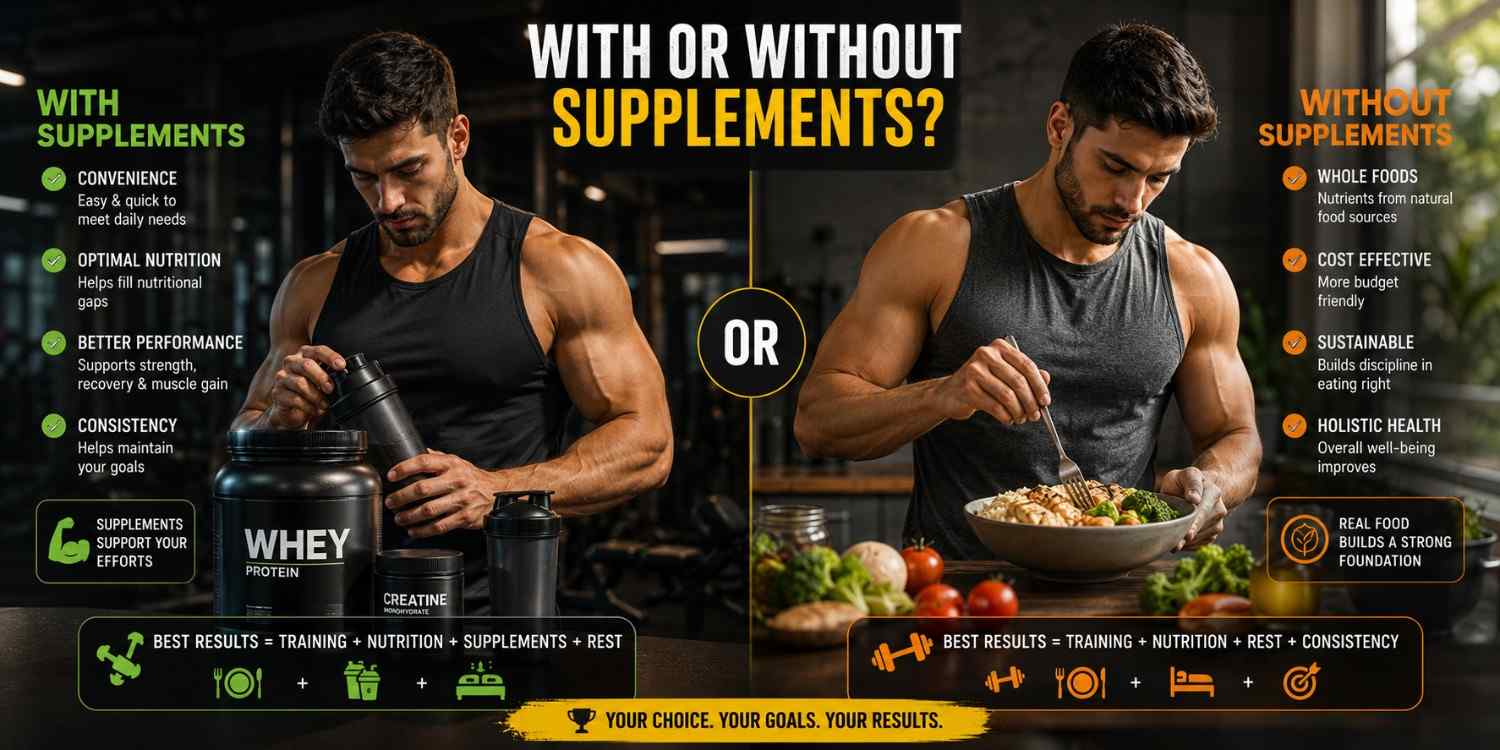
Can you train, recover and progress without supplements? In many cases, yes. A well-planned diet can provide the energy, protein, vitamins and minerals required for an active lifestyle.
Supplements become relevant when food alone does not conveniently meet a specific need. This may happen because of dietary restrictions, limited food access, demanding training, a diagnosed deficiency or the need for a precisely measured performance ingredient.
The choice is not between being completely for or against supplements. The better approach is to understand what you need, why you need it and whether the product can realistically provide it.
1. Build the Food Foundation First
A balanced diet does more than deliver isolated nutrients. It provides combinations of protein, carbohydrates, fats, fibre and micronutrients that support training, digestion, recovery and general health. 1
2. The Vitamin C Example: Do You Really Need 1 Gram?
Supplements are sometimes justified using extreme food comparisons, such as saying that you would need many oranges or litres of juice to obtain 1,000 mg of vitamin C.
Most healthy adults do not require 1,000 mg every day. The recommended daily amount is 90 mg for adult men and 75 mg for adult women. People who smoke are advised to consume an additional 35 mg per day. 2
Vitamin C can be obtained from oranges and other citrus fruits, but also from peppers, kiwifruit, broccoli, strawberries, potatoes and tomatoes. Excessive supplemental intake may cause diarrhoea, nausea or stomach cramps. 2
“A supplement should solve a specific problem, not create the illusion that more nutrients automatically produce more progress.”
3. When Can Supplements Be Useful?
A Better Supplement Decision Process
4. Do Athletes Need Regular Blood Tests?
Blood tests can help investigate symptoms, assess general health, identify risk factors or monitor an existing condition. They may be useful when fatigue, unusual performance decline, dietary restriction or other concerns suggest a possible problem. 3
That does not mean every healthy athlete needs an extensive laboratory panel at frequent intervals. Testing should be selected according to your symptoms, medical history, medicines, diet and risk factors, preferably with professional guidance.
| Situation | Possible Professional Assessment |
|---|---|
| Persistent fatigue or breathlessness | Full blood count, iron status or other tests selected according to symptoms |
| Restricted or highly repetitive diet | Assessment of nutrients most likely to be affected by that dietary pattern |
| Unexplained decline in performance | Review of training load, recovery, health history and targeted testing |
| Known medical condition or medication | Monitoring recommended by the treating healthcare professional |
5. Which Performance Supplements Actually Help?
Different ingredients have very different levels of supporting evidence. A product being popular in gyms does not automatically mean it improves performance.
| Supplement | Common Goal | Evidence Summary |
|---|---|---|
| Creatine Monohydrate | Strength, power and repeated high-intensity exercise | Strong evidence when combined with suitable training |
| Caffeine | Alertness, endurance and selected performance outcomes | Good evidence, but individual response and side effects vary |
| Protein Powder | Meeting daily protein needs and supporting adaptation | Useful when food intake is insufficient or inconvenient |
| BCAAs | Muscle growth, soreness and recovery | Limited additional benefit when sufficient complete protein is consumed |
| Arginine | Nitric oxide, blood flow and workout performance | Evidence for meaningful athletic improvement is limited |
| Taurine | Endurance, muscle function and recovery | Research is developing, with inconsistent practical outcomes |
| Tribulus Terrestris | Testosterone, strength and muscle growth | No credible support for improving athletic performance |
| Guarana | Energy and alertness | Primarily acts as a caffeine source; total caffeine intake matters |
| Fat Burners | Faster metabolism, appetite control and weight loss | Usually limited evidence, variable formulas and possible safety concerns |
NIH guidance concludes that there is little evidence supporting BCAA supplementation for performance or recovery when adequate protein is already consumed. It also reports no scientific support for tribulus terrestris as an athletic-performance supplement. 4
Creatine: One of the Strongest Options
Creatine monohydrate can increase muscle creatine stores and improve capacity during repeated, short-duration, high-intensity activity. It may also support greater strength and lean-mass gains during resistance training.
The International Society of Sports Nutrition identifies creatine monohydrate as one of the most effective ergogenic supplements available for increasing high-intensity exercise capacity. 5
Caffeine and Guarana: Useful but Easy to Overuse
Caffeine can improve alertness and several aspects of exercise performance. However, responses vary because of genetics, habitual intake, body size, timing and individual sensitivity. 6
Guarana naturally contains caffeine. When it appears alongside coffee, tea extracts or anhydrous caffeine, the combined stimulant amount may be higher than expected.
6. Protein Shakes Are Food Supplements, Not Magic Potions
Protein powder is a convenient, concentrated source of dietary protein. Whey and casein are derived from milk, while other products may use soy, pea, rice, egg or blended protein sources.
A shake can be useful when you cannot prepare a meal, have a limited break at work or need an easy way to increase your daily intake. Its value comes from providing protein—not from producing a magical effect that ordinary food cannot achieve. 7
BCAAs: Useful Amino Acids, but Often Unnecessary
Leucine, isoleucine and valine are essential branched-chain amino acids. They contribute to muscle-protein metabolism, but muscle tissue requires all essential amino acids to build complete new proteins.
Meat, dairy, eggs, soy and complete protein powders already provide BCAAs alongside the other essential amino acids. When total protein intake is sufficient, an additional BCAA product may offer little practical advantage. 4
Arginine, Taurine and Tribulus: Keep Expectations Realistic
7. What About Fat Burners?
Products marketed as fat burners may combine caffeine, herbs, fibre, minerals and other ingredients intended to reduce appetite or increase energy expenditure.
There is little scientific evidence that most weight-loss supplements produce meaningful, lasting results. Multi-ingredient formulas can also make effectiveness, dosage and safety difficult to evaluate. 8
8. Food and Supplements Are Not Interchangeable
| Balanced Food | Dietary Supplement |
|---|---|
| Provides a combination of macronutrients and micronutrients | Usually provides one nutrient or a limited combination |
| Can provide fibre, fluid and food structure | Often lacks fibre and the full structure of a meal |
| Supports variety, satisfaction and normal eating habits | Offers convenience and precise serving information |
| Should form the foundation of daily nutrition | Should fill an identified gap or serve a defined purpose |
Supplement Quality and Safety Checklists
- Define the exact reason for using it.
- Check the amount of every active ingredient.
- Avoid hidden proprietary blends.
- Review allergens and dietary suitability.
- Reject guaranteed transformation claims.
- Check medicine and supplement interactions.
- Avoid combining several stimulant products.
- Follow the labelled serving instructions.
- Stop if significant side effects develop.
- Seek guidance for medical conditions.
- Choose independently tested products.
- Verify relevant anti-doping certification.
- Keep records of products and batch numbers.
- Avoid unfamiliar imported formulations.
- Remember that contamination risk cannot be eliminated entirely.
Check the Foundations Before Supplementing
- Are you eating enough total energy?
- Are you meeting your protein needs?
- Are carbohydrates supporting your training?
- Are you eating enough fruit and vegetables?
- Are you including fibre and healthy fats?
- Are you drinking enough fluid?
- Are you sleeping and recovering properly?
- Is your training programme suitable and progressive?
With or Without Supplements: The Final Answer
You can build strength, improve fitness and recover successfully without a large supplement routine. Food, training, hydration, sleep and consistency remain the essential foundation.
Supplements can still be valuable when they solve a genuine problem. Protein powder can provide convenient protein, creatine can support high-intensity training and caffeine can improve selected performance outcomes.
Other ingredients may provide smaller, inconsistent or unsupported benefits. The right approach is therefore not “supplements at all costs” or “no supplements ever,” but food first, evidence second and marketing last.
Frequently Asked Questions
Can I build muscle without supplements?
Yes. Progressive resistance training, adequate total energy, sufficient protein and proper recovery can support muscle development without supplements.
Is protein powder necessary for athletes?
No. It is a convenient option rather than a requirement. Athletes who meet their protein needs through food may not need a protein powder.
Should I take a multivitamin every day?
Not automatically. Multivitamins may help in selected situations, but they cannot replace a varied diet and unnecessary high-dose products may provide no additional benefit.
Do I need 1,000 mg of vitamin C per day?
Most healthy adults do not. Recommended daily amounts are substantially lower, although individual requirements can change in specific medical or lifestyle circumstances.
Are BCAAs useful if I already take whey protein?
Usually not necessary. Whey protein already provides BCAAs together with the other essential amino acids required for muscle-protein synthesis.
Does tribulus increase testosterone?
Reliable research does not support tribulus terrestris for improving testosterone, strength, muscle growth or athletic performance in healthy athletes.
Should athletes have blood tests regularly?
Testing may be useful when symptoms, dietary restrictions, medical conditions or performance concerns justify it. The type and frequency should be guided by individual circumstances.
Which supplement should a beginner take first?
A beginner should first establish consistent training, balanced meals, hydration and sleep. A supplement should only be added after identifying a specific need.
References
- NHS: The Eatwell GuideGuidance on food-group balance, dietary variety, carbohydrates, fruit, vegetables and healthy fats.View Source
- NIH Office of Dietary Supplements: Vitamin CConsumer fact sheet covering recommended amounts, food sources, upper limits and possible side effects.View Fact Sheet
- NHS: Blood TestsGuidance explaining why blood tests are performed and how tests are selected according to symptoms, conditions and medicines.View Source
- NIH: Dietary Supplements for Exercise and Athletic PerformanceEvidence and safety information covering protein, BCAAs, arginine, caffeine, creatine, tribulus and other performance ingredients.View Fact Sheet
- ISSN Position Stand: Creatine SupplementationKreider RB, Kalman DS, Antonio J, et al. Review of creatine safety, exercise performance and clinical applications.View Research
- ISSN Position Stand: Caffeine and Exercise PerformanceGuest NS, VanDusseldorp TA, Nelson MT, et al. Evidence review covering caffeine effectiveness, timing, individual response and safety.View Research
- ISSN Position Stand: Protein and ExerciseJäger R, Kerksick CM, Campbell BI, et al. Guidance on protein intake, exercise adaptation, timing and supplementation.View Research
- NIH: Dietary Supplements for Weight LossConsumer guidance on the effectiveness, cost, interactions and possible risks of ingredients used in weight-loss supplements.View Fact Sheet
- FDA: Weight-Loss Product NotificationsSafety notifications concerning products marketed for weight loss that were found to contain undeclared or dangerous ingredients.View Notifications
References were accessed on July 28, 2026. This article provides general educational information and does not replace personalised medical, dietary or sports-nutrition advice.