Creatine for Women: Benefits, Dosage, Menopause and Common Myths
Learn how creatine may support women’s strength, high-intensity training and healthy ageing, including dosage, water weight, menstrual health, menopause and safety.
Key Takeaways
Introduction
Creatine is often marketed with male bodybuilders, heavy lifting and rapid muscle gain. This has created the impression that it is mainly a men’s supplement or that women who use it will immediately become bulky.
Neither idea accurately reflects how creatine works. Creatine monohydrate may help women maintain training quality, improve selected high-intensity activities and support strength development.
Women-specific evidence remains less consistent than research in men, but creatine may have particular value when combined with structured resistance training and during healthy ageing.
What Is Creatine?
Creatine is a naturally occurring compound used by the body to support energy production. Most creatine is stored in skeletal muscle, where it contributes to the phosphocreatine system.
During short and demanding efforts, phosphocreatine helps regenerate adenosine triphosphate, commonly called ATP. ATP supplies immediate energy for powerful muscle contractions.
Supports repeated sets of demanding strength exercises.
May support short bursts of maximal or near-maximal effort.
Relevant to explosive sports and rapid force production.
May help maintain output across repeated high-intensity efforts.
Does Creatine Work for Women?
Women can respond to creatine supplementation, although results vary between individuals and studies. Research involving active women has reported a mixture of positive and neutral outcomes.
| Potential Outcome | What Research Suggests | Important Limitation |
|---|---|---|
| Strength | Some trials report improvements when creatine accompanies resistance training | Not every trial finds a clear advantage |
| Power and sprinting | May support selected explosive or repeated-effort tasks | Results depend on sport, protocol and training status |
| Lean mass | Small improvements may occur alongside progressive training | Early changes may partly reflect water stored with muscle |
| General exercise | Benefits are most relevant to high-intensity or resistance exercise | Low-intensity activity may produce less noticeable effects |
What Influences the Response?
Creatine and Strength Training
Creatine does not directly force muscles to grow. It may help women perform slightly more high-quality training work by supporting repeated muscular contractions.
May help complete an additional controlled repetition in demanding sets.
May help maintain performance across repeated sets.
Can support the training capacity needed to progress gradually.
May help restore energy between brief high-intensity efforts.
Can Creatine Help Women Build Muscle?
Creatine may support lean-mass development when combined with resistance training, but expectations should remain realistic.
Early increases in lean mass may partly reflect water stored within muscle. Longer-term changes depend on whether creatine helps the user train more effectively over time.
Muscles may appear fuller as creatine and water increase within muscle cells.
Muscle growth still requires progressive training, adequate nutrition and time.
Does Creatine Make Women Bulky?
Creatine does not automatically produce a bulky physique. Significant muscle growth requires progressive resistance training, sufficient nutrition and considerable time.
Some women may notice fuller-looking muscles because creatine increases water associated with muscle cells. This is not the same as unwanted fat gain.
Does Creatine Cause Weight Gain or Bloating?
Creatine can cause a small change in scale weight, particularly during a loading phase. This is normally related to water rather than fat.
| Possible Change | Likely Explanation | Practical Response |
|---|---|---|
| Fuller muscles | Additional water associated with muscle tissue | Usually harmless and not body-fat gain |
| Scale increase | Water change, especially during loading | Use 3–5 grams daily without loading |
| Stomach discomfort | Large single servings or aggressive loading | Reduce the serving or divide it across the day |
Does Creatine Affect the Menstrual Cycle?
There is not enough evidence to conclude that creatine disrupts menstrual cycles in healthy women.
Hormonal changes can influence fluid balance and energy metabolism, but this does not establish that creatine causes irregular periods.
- Low calorie intake
- Rapid weight loss
- High training stress
- Poor recovery
- Pregnancy or medication
- Polycystic ovary syndrome
- Thyroid conditions
- Hormonal contraception
- Low energy availability
- Other medical conditions
Creatine During Perimenopause and Menopause
Creatine has attracted interest among perimenopausal and postmenopausal women because ageing can be accompanied by reductions in muscle mass, strength and bone health.
| Outcome | Current Evidence | Practical Meaning |
|---|---|---|
| Lean mass | Small average improvements have been reported | Benefits appear strongest with resistance training |
| Leg strength | Selected analyses report improved leg-press strength | Creatine may add modest value to structured training |
| Bone-mineral density | No consistent overall improvement | Creatine should not be treated as a bone-health treatment |
| Physical function | Some trials report improvements in selected walking or functional measures | Results depend on programme, dose and population |
Can Creatine Support Brain Function During Menopause?
Creatine contributes to energy metabolism in the brain, creating interest in its possible effects on cognition, mood and mental fatigue.
Early research is promising but limited. Creatine should not currently be treated as a proven treatment for brain fog, depression, sleep disorders or menopause-related cognitive symptoms.
Best Creatine Dosage for Women
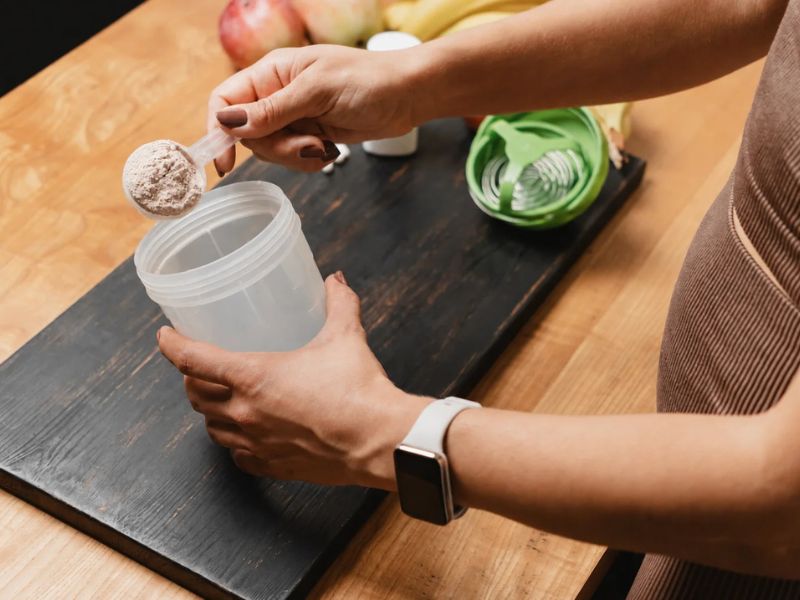
Women generally do not require a completely different creatine dosage from men. The most practical maintenance dose is 3–5 grams of creatine monohydrate per day.
| Approach | Dosage | Best For | Main Consideration |
|---|---|---|---|
| No loading | 3–5 g daily | Simple long-term use | Stores increase gradually over several weeks |
| Loading phase | 20 g daily in four 5 g servings for 5–7 days, then 3–5 g daily | Faster muscle-creatine saturation | Greater chance of temporary fluid or digestive changes |
Does Creatine Need to Be Taken Before a Workout?
Creatine is not an acute stimulant. Its effects depend on gradually increasing and maintaining muscle-creatine stores, so consistency matters more than exact timing.
Which Type of Creatine Is Best?
Creatine monohydrate remains the most researched and practical form. Alternative forms are often marketed as faster acting or less likely to cause bloating, but consistent performance superiority has not been established.
| Creatine Form | Practical Assessment |
|---|---|
| Creatine monohydrate | Most researched, widely available and usually the best-value option |
| Creatine hydrochloride | Marketed for solubility, but not consistently superior for exercise results |
| Creatine ethyl ester | No established advantage over monohydrate |
| Buffered creatine | Marketing claims exceed current evidence |
| Creatine blends | Often more expensive and may hide individual ingredient amounts |
Creatine Buying Checklist
- ✓Creatine monohydrate is clearly listed
- ✓Serving size is transparent
- ✓Manufacturing information is available
- ✓Independent quality testing is provided
- !Unnecessary proprietary blends
- !Claims of instant muscle growth
- !Products hiding the actual creatine dose
- !Untested products for competitive athletes
Is Creatine Safe for Women?
Creatine monohydrate is generally well tolerated by healthy women at recommended dosages. Possible practical effects are usually mild and more common with large servings or loading protocols.
A temporary water-related change in some users.
More likely after a large single serving.
May improve with smaller servings or food.
Can occur during aggressive loading.
Can Women Take Creatine During Pregnancy or Breastfeeding?
Creatine metabolism is being studied during pregnancy, but evidence on routine supplementation remains insufficient.
Pregnant or breastfeeding women should discuss creatine with their obstetrician or healthcare professional rather than beginning supplementation independently.
Who May Benefit Most?
Women following progressive strength or hypertrophy programmes.
Women involved in sprinting, jumping or explosive sports.
Lower dietary creatine intake may increase the potential response.
May help support training quality while food intake is reduced.
May provide additional support when combined with resistance training.
Can be considered as part of a muscle-maintenance strategy.
Common Creatine Myths for Women
Women can respond to creatine, although female-specific research is still developing.
Creatine is an energy-related compound, not an anabolic hormone.
Muscle growth still requires progressive training, nutrition and time.
Water stored with muscle is not the same as body-fat accumulation.
There is no established requirement to stop and restart it in cycles.
Daily consistency is more important than an exact pre- or post-workout window.
A Simple Creatine Plan for Women
Choose Monohydrate
Select a plain, quality-tested product.
Use 3–5 Grams
A loading phase is optional.
Take It Daily
Use it on training and rest days.
Train Progressively
Combine supplementation with structured resistance training.
Monitor Your Response
Track strength, repetitions, digestion, weight and recovery.
Evaluate After Several Weeks
Do not judge the supplement after one or two servings.
- Strength
- Repetitions
- Training volume
- High-intensity performance
- Body weight
- Digestive comfort
- Muscle fullness
- Menstrual symptoms where relevant
The Final Verdict
Creatine is not exclusively a men’s supplement. Women may use creatine monohydrate to support selected high-intensity activities, strength training and training quality.
Evidence in active women is promising but mixed. In postmenopausal women, creatine combined with resistance training may provide small improvements in lean mass and strength, although it has not consistently improved bone-mineral density.
For most healthy adult women, the simplest strategy is 3–5 grams of creatine monohydrate daily, used consistently alongside progressive resistance training.
Frequently Asked Questions
Is creatine suitable for women?
Yes. Healthy adult women can use creatine monohydrate to support selected strength, power and high-intensity training outcomes.
How much creatine should a woman take?
A practical maintenance dose is approximately 3–5 grams of creatine monohydrate per day.
Does creatine make women bulky?
Evidence remains insufficient for routine use during pregnancy or breastfeeding. Speak with an obstetrician or healthcare professional.
References
- Systematic review of creatine supplementation in physically active women
- Review of common questions and misconceptions about creatine supplementation
- Meta-analysis of creatine supplementation in postmenopausal women
- Trial of creatine loading, menstrual-cycle phases and body-water distribution
- Systematic review and meta-analysis of creatine safety in women
- Long-term creatine trial involving postmenopausal women
- Two-year low-dose creatine trial in postmenopausal women
- Study comparing pre-workout and post-workout creatine timing